
Best-laid plans have a habit of being disrupted by events.
Briefings ahead of today’s Spring Statement prepared the country for a ‘boring’ moment with Rachel Reeves parroting Office for Budget Responsibility forecasts.
There would be political gloss with the Chancellor taking credit for falling inflation and interest rates – both of which are the responsibility of the Bank of England.
Reeves was unlikely to take credit for unemployment at 5.2 per cent of the workforce or the 16.1 per cent youth-jobless rate.
The nation cannot watch spiralling events in the Middle East with equanimity. The UK already has the highest electricity prices in Europe (bar Germany).
A spike in the oil price and volatile natural gas prices – the result of blockages in the Strait of Hormuz – can only make matters worse.
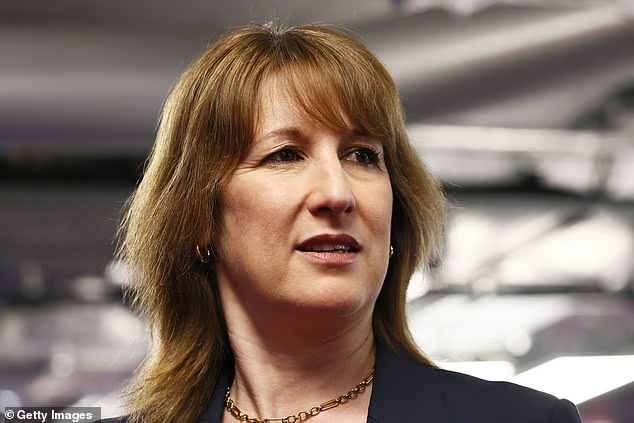
Spring Statement: Chancellor Rachel Reeves is expected to take all the credit for falling inflation and interest rates – both of which are the responsibility of the Bank of England
Britain’s lingering dependence on gas means that an inflation shock from the aerial war on Iran is inevitable. Green shoots of recovery seen in the latest S&P manufacturing survey could be snuffed out.
The risks are not as great as in historic Gulf conflicts. The 1973 Yom Kippur War triggered a great inflation and worldwide recession.
Subsequent conflagrations – the Iran-Iraq war of 1980, Saddam Hussein’s invasion of Kuwait in 1990 and the 12-day war of last year – all had an impact.
Europe is still suffering from the price and growth shock of Russia’s four-year war against Ukraine.
The big difference for the G7 now is that the biggest consumer of carbon fuels, the US, is a net exporter of oil and gas. Nevertheless, Capital Economics estimates that if crude oil prices were to spiral to $100-a-barrel, that would add 0.7 per cent to global prices.
Britain’s lack of energy self-sufficiency – we are dependent on pipelines from Norway and liquefied natural gas shipments from Qatar and the US – makes us vulnerable.
Reeves must also consider the impact of the fall-out from the war against Iran on the defence budget.
The consensus is that Reeves will arrive in the Commons today with fiscal headroom of £20billion to £25billionn owing to surging tax receipts.
Contrary to what politicians on the stump might say, a dramatic fall in net migration, set in motion by the Tories, will punch an epic black hole of £20billion in the public finances between now and the end of this Parliament.
Lower immigration reduces the number of working people paying taxes.
Reeves’ talk of ‘securonomics’ now faces reality. Stresses in Whitehall were evident last week.
It took a last-minute reversal by the Chancellor to find £1billion of extra-spending to keep British helicopter-making at Leonardo-owned, former Westland factories alive.
The current war in the Middle East exposes Britain as under-resourced with insufficient airpower to defend our vital interests fully.
There is an extraordinary funding required if national security is not to be further denuded.
Private grief
Last October there was a dire warning from the International Monetary Fund about the risk posed by bank exposure to the Wild West of the $4.5trillion (£3.4trillion) private credit markets.
A red flag was also hoisted by the Bank of England. Fractures at car parts outfit First Brands and motor finance firm Tricolor were described by JP Morgan boss Jamie Dimon as ‘cockcroaches’.
Now Britain has its very own in the shape of last week’s collapse of Mayfair-based Market Finance Solutions (MFS).
It largely passed under the radar as the nation was focused on the Greens’ victory in the Gorton and Denton by-election and the US and Israel launched their bombardment of Iran.
Yet the MFS failure reached deep into the regulated financial system with Barclays, investment bankers Jefferies (also a victim of First Brands) and private equity concern Apollo among those drawn into the net.
On the other side of the Atlantic, there were heightened fears after Blue Owl, which offers investors a route into private credit, revealed it was selling some $1.4billion (£1.1billion) in loans to help repay clients in older funds and had ended redemptions in another.
It is not a crisis yet, but the first rumbles of a potential earthquake are being felt.
Join the debate
How should Britain balance national security costs with the strain on ordinary families from rising prices?
DIY INVESTING PLATFORMS

AJ Bell
AJ Bell
Easy investing and ready-made portfolios

Hargreaves Lansdown
Hargreaves Lansdown
Free fund dealing and investment ideas

interactive investor
interactive investor
Flat-fee investing from £4.99 per month

Freetrade
Freetrade
Investing Isa now free on basic plan

Trading 212
Trading 212
Free share dealing and no account fee
Affiliate links: If you take out a product This is Money may earn a commission. These deals are chosen by our editorial team, as we think they are worth highlighting. This does not affect our editorial independence.
Compare the best investing account for you