
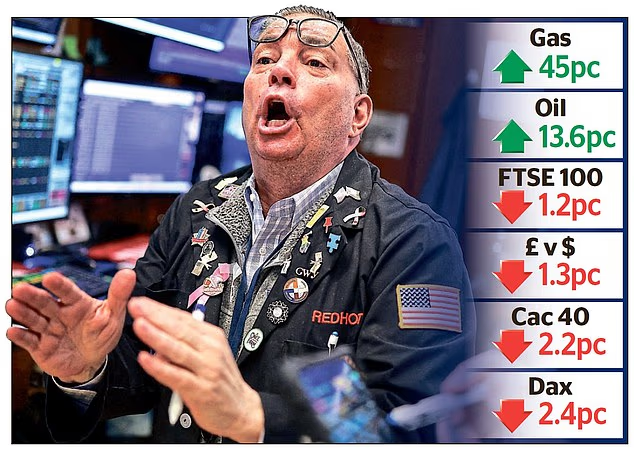
Global stock markets tumbled yesterday as war in the Middle East prompted a spike in oil prices and ramped up uncertainty over the global outlook.
Investors sold shares and bought safe-haven assets such as gold as US strikes on Iran were met with retaliatory attacks across the region.
The FTSE 100 slumped by as much as 1.6 per cent, or 179 points, before clawing back some of its losses to end down 1.2 per cent, or 130 points, at 10,780.11.
There were even bigger falls for Germany’s Dax, down 2.4 per cent, and France’s Cac 40, which sank by 2.2 per cent. US markets later turned positive, however, before sliding back into the red.
Disruption to Saudi oil production and shipping through the Strait of Hormuz – which accounts for a fifth of global oil supplies – helped push the price of a barrel of Brent crude up by more than 13 per cent to as high as $82.37.
It later traded at nearly $78 a barrel – an increase of 7.6 per cent. Analysts said a prolonged conflict could see it hit $100.
Iran shock: Investors sold shares and bought safe-haven assets such as gold as US strikes on Iran were met with retaliatory attacks across the region
The flight from risk drove gold to $5,418.50 per ounce – close to the record high of $5,594.82 it reached in January.
The Footsie’s fall was a sobering start to the month after a 10 per cent rally across January and February that represented its best performance since 1998.
British Airways owner IAG was the biggest faller, down 5.5 per cent, or 23.2p, to 400.5p. Low-cost rival easyJet, already facing a battle to avoid relegation to the FTSE 250, dipped 3 per cent, or 14p, to 450p.
Airline stocks suffer when oil prices rise, and they were also buffeted by the cancellation of thousands of flights due to the conflict.
Cruise operator Carnival also tumbled, with shares falling 8.1 per cent, or 190p, to 2,160p.
Banks were on the back foot as the crisis threatened to push up inflation, potentially derailing interest rate cut hopes and dampening the outlook for the wider economy.
Barclays fell 3.4 per cent, or 15.5p, to 437.35p, Lloyds slipped 2.5 per cent, or 2.53p, to 99.92p, and NatWest closed 2.9 per cent, or 18p, down at 601p.
HSBC, with its greater focus on Asia, saw a bigger hit as it dropped 4.4 per cent, or 61.6p, to 1,332p, while Standard Chartered – focused on Asia and Africa – slumped 5.3 per cent, or 97p, to 1,735p.
The Middle East crisis added to the headache facing bosses already navigating a path through trade wars and consumer cost of living challenges.
‘What we don’t control is the macroeconomic picture and if people decide to throw bombs around,’ Frank van Zanten, chief executive of FTSE 100 supplies firm Bunzl, told the Mail.
His own firm enjoyed a rise of 2.4 per cent, or 52p, to 2,246p after well-received financial results.
Defence and energy stocks helped to prop up the Footsie, with BAE Systems roaring ahead by 6.1 per cent, or 129p, to 2,241p. Oil giant Shell rose 1.9 per cent, or 58.5p, to 3,132p, and rival BP added 2.1 per cent, or 10.2p, to 487.5p.
In New York, stocks initially turned negative before recovering, with sentiment apparently assuaged by hopes that the conflict would prove to have a limited impact.
US Defence Secretary Pete Hegseth said: ‘This is not Iraq. This is not endless.’
Join the debate
How should ordinary investors protect their savings when global conflicts send markets into chaos?
DIY INVESTING PLATFORMS

AJ Bell
AJ Bell
Easy investing and ready-made portfolios

Hargreaves Lansdown
Hargreaves Lansdown
Free fund dealing and investment ideas

interactive investor
interactive investor
Flat-fee investing from £4.99 per month

Freetrade
Freetrade
Investing Isa now free on basic plan

Trading 212
Trading 212
Free share dealing and no account fee
Affiliate links: If you take out a product This is Money may earn a commission. These deals are chosen by our editorial team, as we think they are worth highlighting. This does not affect our editorial independence.
Compare the best investing account for you