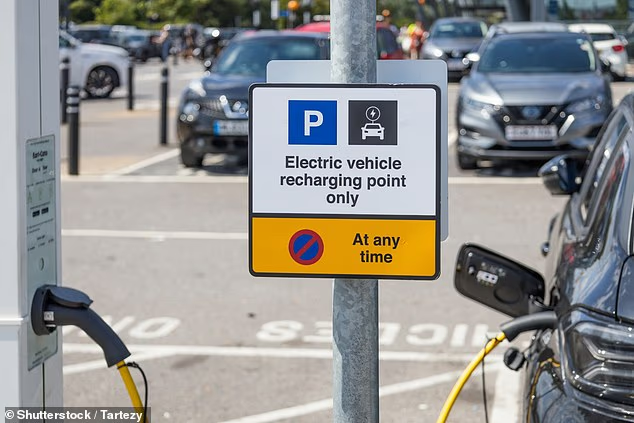
Electric car owners could be paying more for charging than public devices are telling them, a study has found.
A review of public charging points identified that almost one in three provided customers with incorrect readings, meaning less electricity was being zapped into their vehicles’ batteries than the device had led them to believe.
EVCI Global, an independent inspection provider monitoring the EV charging sector, found that 31.5 per cent of chargers it reviewed were either overestimating or underestimating how much energy was being transferred to electric cars.
The findings from its have been submitted to Parliament’s Transport Select Committee, raising concerns that some EV drivers could be paying more than they should.
Around 15 per cent of the chargers tested showed errors of more than five per cent, while a small number were said to have ‘materially larger deviations’ from the correct figures.
The report concluded the inaccuracy of metering on these devices ‘exposed EV drivers to higher financial risk’ than those who fill up traditional cars with petrol and diesel.
A review of hundreds of EV charging points across the country found than one in three are billing drivers the wrong amount
EVCI Global tested hundreds of in-service chargepoints nationwide last year using ‘calibrated, traceable equipment’.
This found that three in ten fell outside the ‘Maximum Permissible Error’ allowance for meters when it came to measuring the supply of voltage being transferred from the grid to the vehicle.
As such, EV owners are far more exposed to overpaying for the amount of energy they’ve paid for compared to those using a fuel pump at a filling station.
Petrol pumps are subject to strict statutory verification and must typically operate within a tight tolerance of -0.5 to +1 per cent.
However, for electric vehicle chargers, the margin for error is more forgiving, allowing for up to +2 per cent.
Yet, the market analysis found that almost a third of public devices measured were outside this threshold.
‘This creates a two-tier system of consumer protection where EV drivers are currently exposed to significantly higher financial risk than drivers of combustion engine vehicles,’ it said.
In its written submission to the transport committee, it highlighted the Chancellor’s plans to introduce a 3p-a-mile tax on EV owners from 2028.
Rachel Reeves confirmed in the Autumn Budget that eVED would bring fairness to the tax system, with petrol and diesel owners paying duty on every litre of fuel they pump into their cars.
But EVCI said a lack of fairness on public chargepoint billing could make EV ownership even less appealing as other costs continue to rise.
Craig Marsden, the company’s chief executive, told The Telegraph that in one case he had measured a charger providing 37 per cent less electricity than its reading claimed.
The report is a double blow to those electric car owners without a driveway and means of charging their EVs at home.

While fuel pumps at filling stations have very tight restrictions on the accuracy of how much petrol or diesel is being transferred, the allowance window is much wider for EV chargers
Those without off-street parking and therefore no access to a homecharger and cheaper domestic energy pricing are reliant on the public network.
But while the infrastructure is growing, pricing is far higher – in some instances, over three times more expensive than plugging in at home.
Public charging costs too are inflated by a 20 per cent VAT levy, which is four times that of the 5 per cent rate EV owners who plug in at their houses incur.
As such, some public EV stations are currently charging up to 89p per kWh, meaning extended charging sessions can cost over £70. Annually, their charging bill can be close to £2,000.
In contrast, those who can charge at home are typically paying 26p per kWh – a figure that will fall further following the Ofgem energy price cap reducing announced last week.
And for some customers with EV-dedicated energy tariffs, the cost of energy can be as low as 7.5p per kWh if they charge during the early hours of the morning when demand is lowest.
That said, a court has very recently ruled that public EV charging should benefit from a reduced five per cent VAT – bringing the tax in line with home charging.
The First-Tier Tribunal Tax Chamber’s landmark decision came after community charge point operator, Charge my Street argued against the 20 per cent tax rate currently imposed on the public charging network on advice from global professional services Deloitte.
EVCI Global has called on the Government to introduce a scheme where a body tests and periodically verifies that charging devices are delivering the energy they claim on screen.
Tanya Sinclair, CEO at the EV policy group Electric Vehicles UK, told Daily Mail and This is Money: ‘Accuracy in energy measurement matters. In several European markets, inaccuracy at a charge point carries clear legal consequences.
‘Drivers should have the same confidence charging an EV as they do filling up at a petrol pump. That principle is straightforward.
‘The right response is evidence-led and proportionate: a regulatory framework that enforces high standards of accuracy and robust verification at the charge point, just as we do for liquid fuels.
‘EU precedent shows that stronger standards and clearer verification are both possible and practical.’
She added that drivers ‘deserve certainty’ and responsibility ‘now sits with government to put the right regime in place’.
ChargeUK said inaccurate chargers identified in the report were ‘isolated’ cases and said measuring the transfer of energy at charging devices is more complex than tracking the amount of petrol coming out of forecourt pumps.
Jarrod Birch, its head of policy, told The Telegraph: ‘Charge point operators, auto manufacturers and drivers all care about accuracy but currently the evidence suggests isolated issues rather than a widespread problem.
‘Electricity is different to fuel. It is harder to measure but charging an EV is also inherently more transparent than fuelling a petrol car. Drivers can see the electricity they have been billed for and the power delivered to their vehicle via their car’s software.’
Mr Birch said the EV charging industry is well aware of these issues and ‘already engaging on this topic’, including its own independent testing and verification.
A Department for Transport spokesman said: ‘Public EV charge points are expected to accurately measure and provide the electricity they state they deliver.
‘Meters used at most public charge points are covered by regulations requiring accuracy to within 2 per cent, which we expect all providers to adhere to.’