
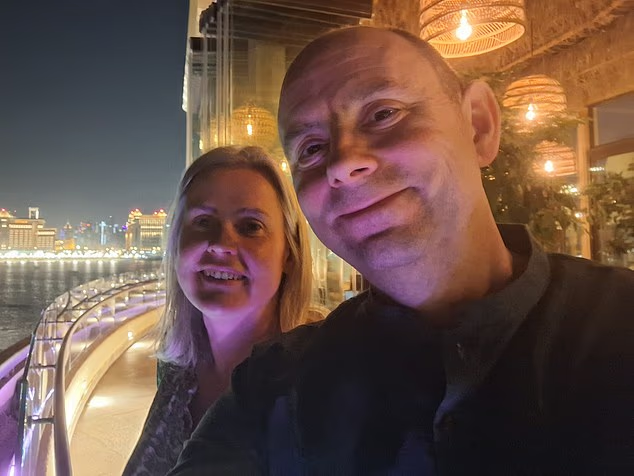
I was standing in the Museum of Islamic Art in Doha on Saturday when the emergency alarm went off and gave me the first indication that my holiday was about to go very wrong.
Was I in danger? What if I was stranded away from my daughters? I had one reassuring thought, though: at least I have decent travel insurance.
It is my first time in the Middle East – travelling with my husband, Paul, who has been at a work conference.
I’d relied, as always, on our comprehensive worldwide travel insurance policy bought as part of our Nationwide-packaged FlexPlus account. It has never failed us yet.
Except it turns out that even the best travel insurance doesn’t usually cover for what are known as ‘acts of war’.
This means that, like hundreds of thousands of others, I must rely on inconsistent and unclear airline recompense policies to recover any extra expenses caused by the unexpected extension to our trip.
Trapped: Rosie and Paul are sheltering in a conference centre in Doha when the conflict with Iran broke out
‘Standard travel insurance policies do not cover war, hostile acts, civil war, military action, invasions or similar large-scale conflict events,’ explains Tim Riley, the chairman of the UK Travel Insurance Association (UKTIA) who also runs travel insurer The True Traveller.
After hearing the alarm, checking the news and realising this wasn’t going to be over quickly, I dashed back to the hotel and packed our bags.
I met Paul at the conference centre to free up our room for people who might otherwise be sleeping on the floor at the airport.
Now everyone has been instructed to ‘shelter in place’, which in the case of the conference centre is just 27 miles from the Al Udeid airbase – Iran’s stated target.
We are being exceptionally well cared for, but aside from the odd game of ping-pong and some sober karaoke, most of the talk among fellow residents is about how and when we will get out.
It’s not really clear how far we should venture. I’ve taken a couple of trips to the local undercover malls which are heaving with people buying food for Ramadan. Some more enterprising people have been out on bikes, but no one is going far.
Tonight it’s ‘barbecue night’, and yesterday we watched a film, but despite the slight all-inclusive holiday atmosphere, loud noises make me jumpy – whether it is the air conditioning kicking in or the sound of missiles being intercepted by the Qatari air defence.
We’re fortunate that our accommodation – and even our laundry – is being taken care of by the conference organisers.
And on Monday we were told the Qatar government is covering hotel expenses of all travellers unable to leave due to cancelled flights – including us.
However, we’re still racking up expenses for cat sitting at home, mobile data for work and about £30 a day on food.
The Nationwide insurance policy, which is provided by Aviva, appears to cover none of these expenses. Its wording states that I am not covered for ‘any consequence whatsoever which is the direct or indirect result of […] war, invasion, act of a foreign enemy, hostilities or warlike operation or operations (whether war has been declared or not), civil war, revolution…’ – the restrictions go on.
Aviva yesterday told me: ‘In the first instance, anyone affected should contact their airline, travel provider or tour operator, who are best placed to support with rearranging flights and covering certain costs or making alternative travel plans.
If customers incur additional costs that cannot be recovered from airlines, travel providers or tour operators, customers may be able to claim for reasonable, unrecoverable expenses.’
I’ve since learned there is one particular phrase those affected should look out for in their policy – and, if there, you stand a better chance of a payout from your insurer.
Anna-Marie Duthie, travel insurance expert at Defaqto, says: ‘Look for wording suggesting they will cover disruptions due to a ‘catastrophe’ – defined as including ‘civil commotion and/or civil unrest assuming the proportions of or amounting to an uprising’.’
Although my insurance may not pay out for my mounting expenses, my airline may cover some. My cancelled flight, which should have been on Monday, was with British Airways, but it is hard to work out what the firm will cover.
Its website lists ‘reasonable costs’ such as hotel accommodation, airport transport and ‘reasonable food and drink, excluding alcohol’. It will also pay for two telephone calls.
But if we are evacuated, it’s less clear who will foot the bill. UKTIA’s Tim Riley says he believes the Government would cough up.
Like all expats stuck here, I have been asked to register online my presence in the region. I’ve received several emails, with yesterday’s update including mentions of some rapid response teams, but not much more about when we might get out.
In the meantime, we’re settling in for the long haul. I’ve bought some more teabags – in the absence of alcohol, it’s the best a Brit can do in a crisis.