
There are some US exports some Britons simply couldn’t live without: Amazon, McDonalds, Starbucks…
But the latest deliveries from the land of stars and stripes might be a supersized order too large for us – and our modest roads.
A new business has launched this month offering to bring some of the most popular US luxury cars exclusively sold in the States to UK customers.
GM Specialty Vehicles allows Britons to get their hands on some of the most ‘desirable and powerful vehicles’ direct from General Motors’ North American car range.
This includes favourites like the Cadillac Escalade and GMC Yukon – SUVs that for years have been loved by American sports stars, rap artists and affluent families.
But there’s a good reason why they’ve not been sold in the UK before now: because they are absolutely enormous and incredibly thirsty on petrol.
In fact, the scale of some of these vehicles is so large that they wouldn’t even fit in a typical car park space, analysis by Daily Mail and This is Money reveals.
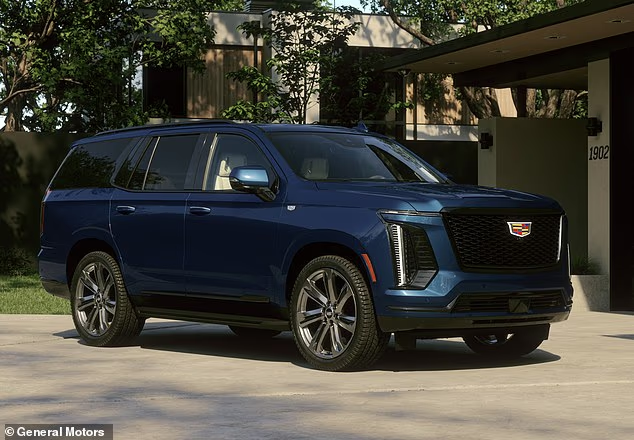
The Cadillac Escalade is now available to UK customers, despite exclusively being sold in North America. But is this hulking SUV too big for our roads?
Their availability comes as various safety groups have dubbed today’s SUVs ‘a growing threat to public safety’ and claimed they are 44 per cent more likely to kill pedestrians and cyclists than smaller vehicle when crashes occur.
And with fuel prices likely to rise on the back of conflict in Iran, now might not be the best time to order a motor that returns just 14.3 miles to the gallon.
GM Specialty Vehicles has made hulking American models available to Britons via London dealership, Clive Sutton.
The St John’s Wood showroom has 35 years of experience importing US-only motors to the UK.
For years, it is one of the only places in Britain where motorists can order a new Ford Bronco – an iconic name in the US market – or a four-tonne electric Hummer.
Sales are arranged directly with General Motors and each UK-market model includes a three‑year, unlimited‑mileage warranty with two further years’ cover as an optional extra. This is to give additional peace of mind given the difficulty accessing parts for these North America-only cars.
The vehicles are not converted to right-hand-drive, meaning UK customers will have to make do with steering from the wrong side of the cabin.
Clive Sutton said the specialist service is an ‘exciting moment for UK customers who have long admired GM’s premium and performance lineup’.
But given their monumental scale, those ordering one of these US cars needs to bear in mind the difficulty of driving them on UK roads, which are far smaller than US highways.

Even the standard Escalade (pictured), which costs from £149,950, is 2.38 metres wide and 5.38 metres long. You won’t be able to squeeze one into a typical UK
Are these American cars too big for Britain?
To understand the sheer scale of some of these American motors, first we must outline the dimensions at play in the UK.
For almost 150 years, the standard lane width on British roads has been 3.65 metres (12 feet).
However, rules for newly constructed highways recommend the width of a motorway lane should be 3.6 metres. For trunk roads, lanes should be 3.2 metres on dual carriageways with a central division or 3.7 metres for each direction of a single carriageway.
For new rural roads, the Government recommendation is for a conventional road to be 5.5 metres across (so slightly less than 2.75 metres per lane) and the minimum width for a single-track road is 3.5 metres in total.
It means any motor in excess of two metres in width feels extremely large on Britain’s humble A and B roads.
And what about parking spaces?
According to the British Parking Association, guidelines for a typical UK parking space have remained unchanged for decades at 2.4 metres wide by 4.8 metres long.
And already, these dimensions are proving restrictive for some European made cars, some of which are longer than a conventional space allows.
Some councils in recent years have even taken to banning models from using local authority-ran car parks if they exceed 5 metres in length and therefore cannot fit inside a bay.
Wokingham, South Hams, Broadland and South Norfolk, and West Devon councils are among those that enforce length restrictions in car parks – and all nine GM models available from Clive Sutton fall foul of the 5-metre rule.
The most popular – and arguably best known – of the new US imports is the Cadillac Escalade SUV, which is available in three variants.
The standard model, which costs from £149,950 in the choice of Luxury or Sport trim, is 2.38 metres wide (with the wing mirrors in the out position) and 5.38 metres long – more than half a metre longer than the typical UK parking bay.
With the mirrors folded in, the width is 2.06 metres, which allows for just 17cm of space to open the doors on either side of the vehicle when parked bang in the centre of a bay.
The long-wheelbase Escalade ESV is also available, which offers three rows of seats and is priced from £180,000.
Its total length is a staggering 5.76 metres – around half a metre longer than the largest Range Rover and almost a metre more than a typical UK parking space – and it weights between 2.6 and 2.8 tonnes depending on spec.
Both Escalades are powered by the company’s naturally aspirated 6.2-litre V8 engine, which return just under 19 miles per gallon (mpg). That’s going to mean regular trips to filling station forecourts at a time when petrol prices are predicted to soar on the back of the outbreak of conflict between the US and Iran.
But if you thought 19mpg was gas guzzling, UK customers can upgrade to the £199,950 Escalade-V.
While it shares dimensions with the standard model, under the bonnet is a supercharged version of the V8 engine which sees the mpg figure fall to a paltry 14.3mpg.
CO2 emissions of 469g/km also easily place this in the highest tax band for Vehicle Excise Duty.
In fact, that’s the case for all nine models available. It means the first-year ‘showroom tax’ rate is £5,490, followed by £620 for the subsequent five years inclusive of standard-rate VED and the expensive car supplement levied on all models priced over £40k.
And these VED rates will increase from April under proposed road tax hikes.

Nine different models from three brands are available from GM Specialty Vehicles through the London-based Clive Sutton dealership. This includes the massive GMC Yukon

The one with the largest footprint of all 9 American cars you can get your hands on is the Chevrolet Silverado ZR-2 pick-up, which is a monumental 2m tall and almost 6 metres long
The new business also gives UK customers direct access to the Chevrolet Tahoe, Suburban and GMC Yukon SUVs, all of which are rebodied versions of the Escalade, meaning they are almost identical in both dimensions and fuel economy.
They all use the same 420bhp naturally aspirated 6.2-litre V8 engine as the base Escalade with prices starting from £86,000 for the Tahoe, rising to £110,000 for the Yukon.
A range of pick-ups – also based on the same platform but measuring up to 5.9 metres in length – are also available, including the Chevrolet Silverado and GMC Sierra costing from £66,000 plus VAT.
The most expensive of all is the whopping Silverado ZR-2, which is a massive two metres high and features locking front and rear differentials, knobbly all-terrain tyres and a starting price of £75,000, plus tax.
Eco and safety campaigners already taking aim at SUVs for being too big
To availability of new – larger – cars from the US market is bound to cause a stir.
According to market analysis conducted last year, half of all new model variants in UK showrooms are already SUVs.
There were 193 different SUV and ‘crossover’ (conventional hatchbacks with increased ride height) variations across the 35 most popular brands when the study was conducted less than a year ago.
This represents an uplift of 543 per cent compared to 2000 when just 35 SUV variants were available.
It explains why the average width of new models sold in the UK are growing on average by a centimetre every two years.
But while their larger dimensions provide improved protection for occupant, many road safety groups are concerned that they are an increased risk to vulnerable road users, especially pedestrians and cyclists.

Analysis by Loughborough University on behalf of T&E in 2025 found that a driver of a RAM TRX truck is unable to see a child up to 9 years old directly in front of their bumper
Transport & Environment, a Brussels based green think tank, last year said the growth in scale of new motors – especially the increasing popularity of SUVs – has become a ‘clear and growing threat to public safety’.
According to a study last year – which analysed over 680,000 accidents from across the last 35 years – it found that pedestrians and cyclists are 44 per cent more likely to be fatally injured if hit by an SUV compared with a ‘regular’ car.
Even more shocking is that it claimed the risk level jumps to 82 per cent for children.
This is because pedestrians and cyclists are at greater risk of being dragged under an SUV rather than bounce off the bonnet, the latter of which is more likely to occur with conventional hatchback and saloon models that are closer to the ground and have smaller grilles.
The report also highlighted taller SUV bonnets as creating an even greater risk as drivers of these models with huge grilles and bumpers are unable to see what’s directly in front of the car, including the average 9 year old.

Wide load: Transport & Environment says the wider cars are not only difficult to fit into parking spaces but they also leave less room for other road users
T&E just 12 months earlier had taken aim at ‘mega SUVs’ that are more than two metres wide – including the Range Rover – for being too big for city streets and kerbside parking spaces, and as such are ‘forcing cyclists off the road’.
SUVs are also worrying critics when it comes to their image on road surfaces.
A senior transport campaigner at Greenpeace last year told us: ‘SUVs create bigger potholes and bigger safety risks, given they take up more room on the road.’
However, according to the Asphalt Industry Alliance, it is decades of underinvestment that is the main cause of road deterioration and not vehicle weight.
There too is an ongoing debate around the environmental impact of heavy SUVs.
A report by the International Energy Agency published in 2024 said they are responsible for ‘over 20 per cent of the growth in global energy-related CO2 emissions’ recorded the year earlier.
‘If SUVs were a country, they would be the world’s fifth largest emitter of CO2,’ it stated.

A report by the IEA in 2024 calculated that if SUVs were a country, they would be the world’s fifth largest emitter of carbon dioxide behind China, USA, India and Russia