
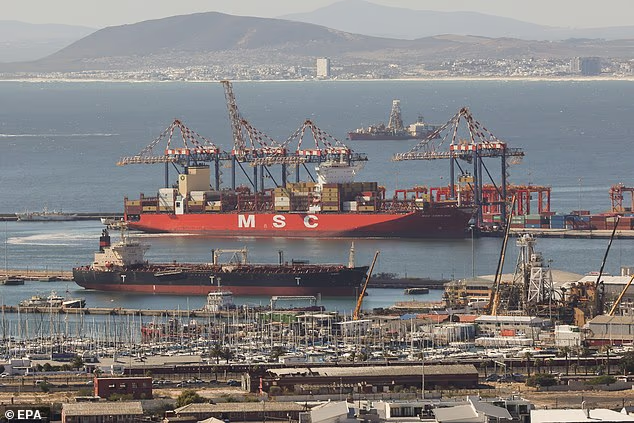
War across the Middle East risks piling pressure on supply chains and pushing up costs for shoppers at grocers in Britain in the long term, experts warn.
Since the conflict started, eyes have turned to the potential impact of the conflict on energy prices and oil trading.
Global crude oil and European gas futures have surged in recent days, adding to fears that energy bills will rise again.
If the conflict persists, the narrative could broaden and ‘turn into a household budget story’, Simon Geale, chief procurement officer at Proxima, told This is Money.
Across Britain’s agricultural, food and drink and manufacturing sectors, there is growing concern about the conflict’s potential impact on food supply chains, and what this will mean for prices at supermarket tills.
So will households have to fork out even more for their food, or will it be business as usual?
Delays: Shipping giants have suspended shipping through the Strait of Hormuz
Shipping delays
While Britain does not source large volumes of food from the Gulf, grocery supply chains are interconnected on a global scale.
Shipping giants, including Danish Maersk, have suspended shipping through the Strait of Hormuz, causing chaos to global supply chains.
‘During previous shipping disruptions, rerouting via much longer routes was increasing fuel and voyage costs by 30 to 60 per cent in some cases.
‘These costs tend to work their way through to consumers,’ Geale said.
Reports since the weekend suggest some British exporters have seen transit times extended and emergency surcharges of up to $3,500 per container.
Both sea and air routes are shut around the Persian Gulf, with Iran’s blockade of the Strait of Hormuz triggering a shock in energy markets. As a consequence, some shipments are having to be rerouted to alternative ports.
Richard Fattall, co-founder and chief executive of Zencargo, told the Grocer: ‘If this carries on, the result is fewer ships available when they’re needed, longer delivery times, higher transport costs, and less reliable schedules for both sea freight and air cargo.’
Delayed shipments will push insurance and freight costs higher and increase energy costs, which will be passed onto households.
And product shortages could become an issue if the conflict is drawn out for a prolonged period.
Experts at commodity price reporting agency Expana have warned that products such as Asian shrimp could become increasingly scarce, as shipments to Europe as delayed and rerouted via the Cape of Good Hope.

Rerouted: On 1 March 2026, Strait of Hormuz traffic plummeted by 86%
Some nut and dried fruit exporters were already facing problems supplying key markets.
Iran is a major supplier of dates, pistachios, walnuts, almonds and saffron. Disruption to its supply routes and chains are likely to have a knock-on effect on global supply levels of these products, Expana said.
But the conflict could also bring down the price of other items, particularly from shipments that are dislodged and shipped to alternative decisions.
Given one example, experts at the Association of Independent Meat Supplies said supplies of poultry and beef from Brazil aimed for the Middle East could be redirected to Europe.
The AIMS said this could drive down costs for consumers in Europe, and see a greater number of EU exports, like Irish beef, enter Britain’s food market.
Higher fertiliser costs will feed through
Higher fertiliser costs are also becoming a problem for the agricultural and food sector. When energy prices increase sharply, fertiliser costs typically follow.
Urea, a key component of fertiliser which is derived from natural gas, has seen its price rise by a quarter since the start of the war.
A spokesperson for the National Farmers’ Union of England and Wales told This is Money that natural gas accounts for between 60 to 80 per cent of the input costs associated with the production of nitrogen fertilisers.
‘Any price rises in the key inputs of diesel and fertiliser at this time of year could undermine farm profitability’, the NFU spokesperson added.
Geale, of Proxima, said: ‘For many crops, farmers’ fertiliser can hit 10 to 15 per cent of production costs, and so these farmers will see a secondary price spike alongside fuel costs.
‘Even though the UK does not heavily source from these regions, the nature of global markets means that our prices will go up even though supply may remain constant.’

Going up: Higher fertiliser costs are, in the longer-term, expected to lead to higher prices for consumers
Geale expects entire supply chains to be affected by higher fuel and energy costs as a result of the conflict.
NFU president Tom Bradshaw, added that Middle East conflict would have a knock-on effect on the future availability and price of fuel and fertiliser.
Sustained price rises will squeeze margins or reduce crop yields, experts warn, but it will take some time to feed through.
Nicholas Found of Retail Economics said: ‘We are seeing immediate price volatility, but at this stage it is too early to say how the UK may be impacted in the medium term.
‘Food supply chains rarely operate on spot pricing and the UK sources much of its food from European markets rather than routes through the Gulf, which provides some insulation from short-term disruption.’
He added: ‘The risk isn’t an immediate spike at the checkout, but a slow-burn within the agricultural supply chain, nudging food inflation higher later in the year if energy markets remain volatile.’
Will shoppers see a difference at the tills?
If higher fertiliser and fuel costs persist, the risk of renewed and higher food inflation later in the year looks set to become more pronounced.
In the short-term, Found said, grocers are likely to feel more pressure from higher oil prices, which raise the cost of transportation, refrigeration and logistics across the food supply chain.’
James Walton, chief economist at IGD agreed that any impact for shoppers would not be immediate.
‘Historically, rising energy prices have been reflected in rising food prices and we would expect an uptick in food prices for shoppers, with inflation likely peaking after around a year because of the lag in costs flowing through the supply chain.
‘However, the ultimate impact on prices for shoppers will depend on unknown variables such as the duration of conflict and damage to oil and gas facilities.’
Geale expects the price of items like bread, pasta, cereals, potatoes and animal feed will increase for consumers.
He added: ‘Food price inflation has been relatively stable in the last 12 months; we would probably expect to see food inflation rates edge up by around 15 to 20 per cent relative to the current level.
‘So, rather than the 3.5 to 4 per cent we see currently, something closer to 4.5 per cent to 5 per cent.
‘In theory, there should be a lag as cost increases work their way through the system, although some producers and retailers may act now to protect margins, which are traditionally thin in this sector.’
While British households could face higher costs at the tills in the longer run, parts of the Middle East face a considerably more acute food supply crisis as a result of the conflict.
Certain areas in the Middle East are already being cut off from vital food imports as vessels avoid the Strait of Hormuz, raising the risk of shortages across the Gulf and piling pressure on already high food prices in Iran.
DIY INVESTING PLATFORMS

AJ Bell
AJ Bell
Easy investing and ready-made portfolios

Hargreaves Lansdown
Hargreaves Lansdown
Free fund dealing and investment ideas

interactive investor
interactive investor
Flat-fee investing from £4.99 per month

Freetrade
Freetrade
Investing Isa now free on basic plan

Trading 212
Trading 212
Free share dealing and no account fee
Affiliate links: If you take out a product This is Money may earn a commission. These deals are chosen by our editorial team, as we think they are worth highlighting. This does not affect our editorial independence.
Compare the best investing account for you