
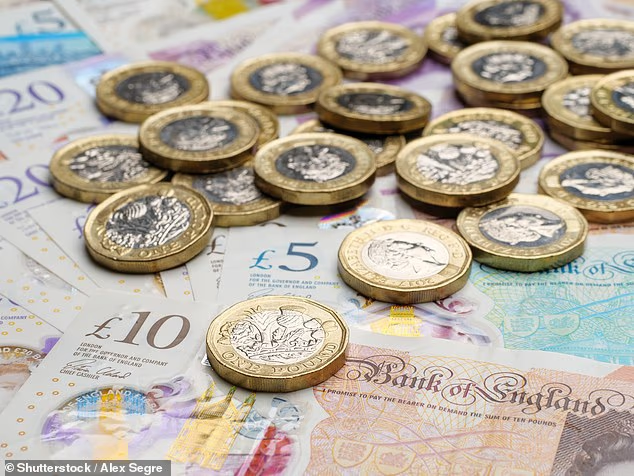
Investors are set to be clobbered for billions of pounds more in capital gains tax following the stock market rally at the start of this year, according to a new official forecast.
The taxman could cream off an extra £3.7billion a year on average – with a windfall of £5billion for the Treasury in 2030/31 alone – after a much better than forecast market performance in early 2026.
Investors have been hit with massive capital gains tax raids by both former Chancellor Jeremy Hunt and his successor Rachel Reeves.
She could now take a huge extra cut of their profits after the stock market surge in recent months.
The FSE 100 has hit a series of record highs, and even after the sell-off following the US-Israeli attack on Iran the index is up more than 5 per cent since the start of the year, and almost 18 per cent on a year ago.
Capital gains tax is levied on profits from assets such as shares, as well as second homes, buy-to-let properties and personal possessions.
The rates for stocks and shares gains were hiked in the last Autumn Budget to 18 per cent for basic rate taxpayers and to 24 per cent for those paying higher rates of tax.
Windfall for Treasury: Capital gains tax is levied on profits from assets including shares
The rises, from 10 per cent and 20 per cent respectively, brought them into line with the already higher levies on property gains and took effect immediately.
There is an annual capital gains tax-free allowance, which is currently £3,000, and the tax is charged on profits above this.
However, this allowance was £12,300 until April 2023, which meant CGT was typically levied on wealthier taxpayers.
Under radical cuts imposed by Hunt, this was slashed to £6,000 in spring 2023 and £3,000 from April 2024, making it inevitable that many more ordinary investors now have to pay capital gains tax.
In the Office for Budget Responsibility’s new forecasts, published today alongside the Spring Statement, it revised up anticipated receipts from capital taxes, with the bulk of the increase to be garnered from CGT.
In its report it says around three-quarters or £9billion of it will be driven by higher-than-expected equity prices.
These are expected to be around 8 per cent higher than assumed in last November’s forecast, based on the recent performance of the FTSE All-Share index.
‘CGT is charged on the gain rather than the value of equity, so the impact of higher equity prices is amplified by a “gearing” effect where 1 per cent growth in equity prices results in 2.7 per cent growth in CGT liabilities on financial assets,’ says the OBR.
‘In this forecast, higher equity prices drive an increase of around £3.7billion a year on average in CGT receipts over the forecast period, reaching £5billion in 2030-31.’
The OBR also expects the Treasury to rake in an extra £500million a year from self-assessed income tax, £300million a year from inheritance tax, £400million a year in stamp duty on shares, and £600million a year in interest and dividend receipts, due to the equity price increase.
But it adds: ‘The forecast assumes a steady increase in equity prices, but in practice equity prices are highly volatile from year to year, which has led to large differences between forecasts and outturns for these tax heads.
‘The increase in receipts at this forecast could therefore easily be reversed by a fall in equity prices.’
According to OBR forecasts, the Treasury is now set to rake in £34.9billion in 2030-31 from CGT. In November 2025, CGT was forecast to hit a smaller £29.8billion.
DIY INVESTING PLATFORMS

AJ Bell
AJ Bell
Easy investing and ready-made portfolios

Hargreaves Lansdown
Hargreaves Lansdown
Free fund dealing and investment ideas

interactive investor
interactive investor
Flat-fee investing from £4.99 per month

Freetrade
Freetrade
Investing Isa now free on basic plan

Trading 212
Trading 212
Free share dealing and no account fee
Affiliate links: If you take out a product This is Money may earn a commission. These deals are chosen by our editorial team, as we think they are worth highlighting. This does not affect our editorial independence.
Compare the best investing account for you