
The world’s biggest oil exporter has warned of ‘catastrophic consequences’ as the Iran war disrupts shipping in the Strait of Hormuz – even as global stock markets bounced back.
While crude prices have fallen sharply since Donald Trump said the conflict in the Middle East was ‘pretty much’ over, the artery through which one fifth of the world’s oil passes remains effectively closed.
The American president warned Iran would face ‘death, fire and fury’ if it continues to choke supplies through the Strait.
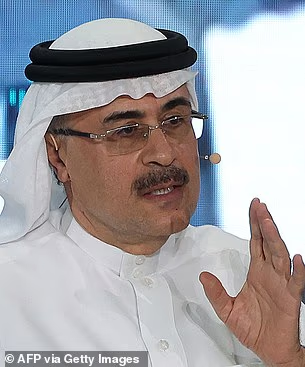
Saudi Aramco chief Amin Nasser
But Iran’s Revolutionary Guard hit back, saying it would not allow ‘one litre of oil’ to be shipped from the Middle East if US and Israeli airstrikes continue.
Claims that the US Navy had escorted a tanker through the Strait – later denied – prompted further swings in the oil price.
Crude fell towards $80 a barrel on Tuesday evening having been close to $120 in early trading on Monday.
‘This is the market reacting to the possibility that the Strait of Hormuz could reopen,’ said Andrew Lipow, founder of Lipow Oil Associates.
But with the war still raging, despite Trump’s suggestion the end was approaching, the boss of Saudi Aramco sounded the alarm over the impact of prolonged disruption in the Strait.
‘There would be catastrophic consequences for the world’s oil markets, and the longer the disruption goes on, the more drastic the consequences for the global economy,’ said Aramco chief executive Amin Nasser.
‘While we have faced disruptions in the past, this one by far is the biggest crisis the region’s oil and gas industry has faced.’
The comments came just days after Qatar’s energy minister warned war in the Middle East could ‘bring down the economies of the world’.
Oil exporters including Saudi Arabia, Iraq, the UAE and Kuwait have slashed production as the closure of the Strait pushes their storage facilities to breaking point.

Anchored: Tankers laden with oil are unable to pass through the Strait of Hormuz
Even if the war ends, it will take time for oil supplies to rebound, warned Simon Flowers, chairman and chief analyst at energy consultancy Wood Mackenzie.
‘When the conflict ends, cranking up the supply chain won’t be swift,’ he said. ‘Barrels in storage at refineries or in port might be moved on vessels quite quickly. But if wells are shut-in for a prolonged period, restarting production to full output could take weeks or even longer.’
The warning came as the oil price tumbled towards $80 a barrel having soared as high as $119.50 in early trading on Monday before Trump suggested the war may be close to an end.
Stock markets bounced back with the FTSE 100 closing up 1.6 per cent at 10,412.24 – though it remains down 4.6 per cent since war erupted 11 days ago.
The Dax rose 2.4 per cent in Germany and the Cac was 1.8 per cent higher in Paris following overnight gains in Asia.
Russ Mould, investment director at AJ Bell, said Trump’s comments ‘have been seized upon’ by investors desperate for good news.
‘The market is in highly speculative mode thanks to the absence of any certainty about what the next few days, let alone weeks will look like,’ he added.
Despite the fall in the oil price, it is still up from around $70 a barrel before the US and Israel attacked Iran at the end of last month.
The surge in the price of oil is already feeding through to higher petrol prices and threatens to add hundreds of pounds to household energy bills.
And the prospect of an inflation shock has seen lenders raise mortgage rates as the war leaves Britain on the brink of a new cost of living crisis.
‘For global markets the critical issue remains the Strait of Hormuz, which remains effectively closed,’ said Ryan Djajasaputra, an economist at Investec.
‘Hundreds of tankers and cargo vessels are now either trapped in the Gulf or in limbo outside the Strait, disrupting the transit of everything from oil and gas to fertiliser and aluminium.
‘The risk is that energy prices remain elevated for some time and with it the associated macroeconomic consequences.’
DIY INVESTING PLATFORMS
AJ Bell
AJ Bell
Easy investing and ready-made portfolios

Hargreaves Lansdown
Hargreaves Lansdown
Free fund dealing and investment ideas

interactive investor
interactive investor
Flat-fee investing from £4.99 per month

Freetrade
Freetrade
Investing Isa now free on basic plan

Trading 212
Trading 212
Free share dealing and no account fee
Affiliate links: If you take out a product This is Money may earn a commission. These deals are chosen by our editorial team, as we think they are worth highlighting. This does not affect our editorial independence.
Compare the best investing account for you