
Rattled investors have been offered a day of temporary relief as Donald Trump indicated the Iran conflict will end ‘very soon’.
The US President’s statement was seen as an attempt to stabilise oil markets, alongside a G7 commitment to tap oil reserves.
After a volatile start to the week, Brent Crude prices fell to $84 a barrel today, having reached $120 at one point on Monday.
Stock markets also reacted positively, with the FTSE 100 gaining 163 points to close the day up 1.6 per cent at 10,412.2
Other European indices were in the green after Asian markets recovered some of its losses overnight. Germany’s Dax closed 2.4 per cent higher, whiole France’s CAC 40 rose 1.8 per cent and Italy’s FTSE MIB climbed 2.7 per cent.
Investors have seen stock market confidence shattered over the past week as high-flying markets have sunk on the emergence of war with Iran.
‘A relief rally is now taking hold as hopes lift that an end to the conflict could be in sight,’ said Susannah Streeter, chief investment strategist at the Wealth Club. ‘But given that the fighting is continuing and the key Strait of Hormuz remains impassable, worry is still percolating.’
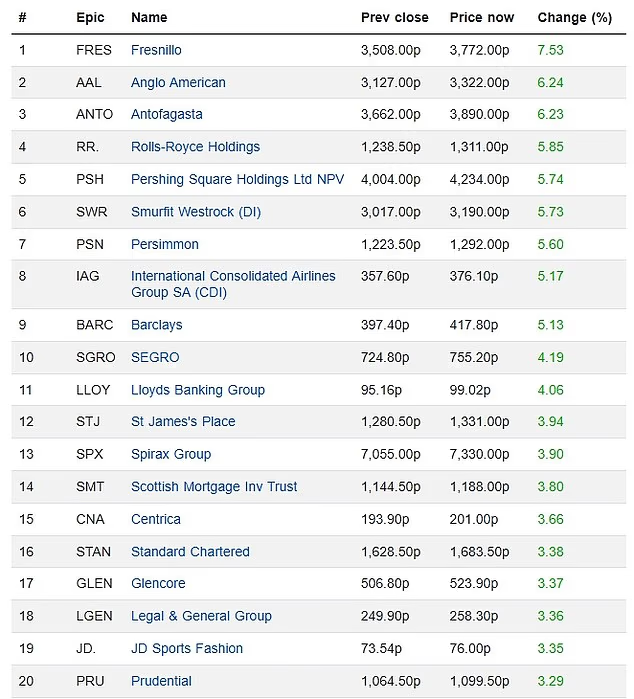
The FTSE 100’s 20 biggest risers on 10 March 2026 as a relief rally took hold
There is no sign that the Strait of Hormuz will reopen, even after Trump said he would hit Iran ‘twenty times harder than they have been hit thus far’ if it ‘does anything’ to stop the flow of oil.
Meanwhile, Saudi Arabia joined other countries in cutting oil output as storage fills up, in a further sign of disruption.
While Trump has pledged the US Navy will escort tankers through the Strait, there is very little detail on how and when this would work.
‘Until a longer-term resolution is found, companies and consumers are still set to pay the price for the attack by the US and Israel on Iran,’ said Streeter.
‘The repercussions for an array of everyday costs affecting companies and households are becoming clear.’
Oil prices are more than 25 per cent higher than at the start of the conflict, while UK gas futures have doubled, fuelling concern about what it means for household energy bills.
In Britain, gilt yields spiked on Monday on heightened inflation fears but pared their losses the afternoon.
Today five and 10-year gilts fell back to 3.99 per cent and 4.50 per cent, respectively.
Traders have slashed the chances of a UK March rate cut to near zero and expect no rate cuts this year.
On Monday, there was growing speculation that the Bank of England would need to raise rates later this year, but this seems to have been misplaced.
Neil Wilson, UK investment strategist at Saxo said: ‘A Bank of England rate cut this month may be back on the table (although I would argue it was never off the table). It completes a pretty madcap couple of days for the markets.’
He added: ‘The risks are still high, just not as elevated as predicted over the weekend. And as colleague suggested yesterday morning, Trump had to do something to calm markets – so this cannot be seen as a sign peace is about to break out – there is a tactical element to these comments, but nevertheless it underlines that the US isn’t going to push this to breaking point, which removes some of the fatness from the tails to the risk picture. Not the beginning of the end, but the end of the beginning.’
DIY INVESTING PLATFORMS

AJ Bell
AJ Bell
Easy investing and ready-made portfolios

Hargreaves Lansdown
Hargreaves Lansdown
Free fund dealing and investment ideas

interactive investor
interactive investor
Flat-fee investing from £4.99 per month

Freetrade
Freetrade
Investing Isa now free on basic plan

Trading 212
Trading 212
Free share dealing and no account fee
Affiliate links: If you take out a product This is Money may earn a commission. These deals are chosen by our editorial team, as we think they are worth highlighting. This does not affect our editorial independence.
Compare the best investing account for you