
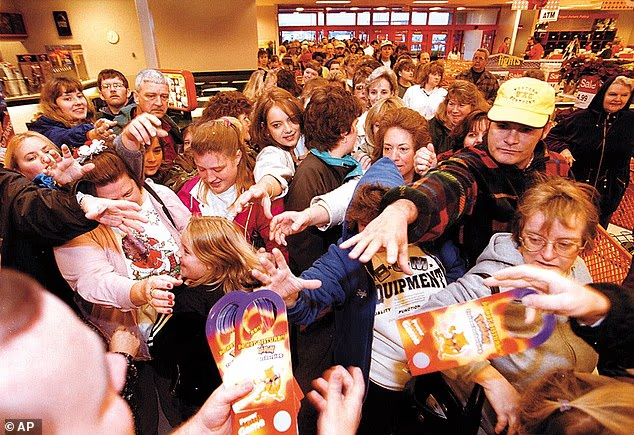
In the late 1990s and early 2000s, the world was awash with trading cards, as kids and adults alike found themselves wrapped up in the Pokémon craze.
Launched in 1996 in Japan, Pokémon cards capitalised on the success of the Pokémon Nintendo Game Boy games, and were launched in the US, UK and Europe in 1999.
Recently, Pokémon marked its 30th anniversary, launching a year-long campaign earlier in late-February which will see new products announced throughout 2026.
While the heyday of trading card popularity might be long since over, there are still tens of thousands of Pokémon card collectors in the UK.
Worldwide, there are millions of fanatics, and billions of Pokémon cards are sold each year.
Over recent years there has been something of a resurgence in trading card popularity on the back of the rise in online reselling platforms, the Pokémon Go mobile game and the pandemic – not to mention a return to wanting to hold a physical asset.
Meanwhile, US influencer Logan Paul sold a rare Pikachu card last month for nearly $16.5million – or £12million – after 41 days of furious bidding.
He snapped that card up for £3.8million in July 2021, a return of more than 200 per cent in under five years.
Back in the 1990s, Pokémon was at its peak of popularity across the globe
Pokémon have dominated the trading card market, and are seen as part of ‘the big three’ alongside Magic: The Gathering cards and Yu-Gi-Oh! Cards.
Over recent years, the trading card market as a whole has been booming, and everything from sports cards to Disney cards are netting huge prices from devotees.
There are signs that Pokémon cards are also benefitting from this growth. Live selling platform Whatnot said UK Pokémon card sales on its platform surged 282 per cent in 2025 compared to the year before.
It said the average order value was £155.
While sports cards can benefit from athlete autographs to drive value, when it comes to Pokémon and the other members of the so-called big three, however, the most valuable cards are the retro originals produced in the nineties.
Many aficionados, or collectors in years past, who may have packed up their cards long ago, now might find the draw to dust off their collections and consider cashing in.
In the reselling market, these products can still attract serious money and demand from enthusiasts.
Can you sell your Pokémon cards?
Many will be hoping that somewhere in their loft or garage there is a trove of some forgotten treasures waiting to be uncovered.
The reality, however, is that most Pokémon card collections stashed away from years past are unlikely to be worth much.
Pokémon investor Adam Leslie told This is Money: ‘I bought a collection from a guy on Facebook Marketplace who had found them in his loft… but from an investment perspective this is a worst-case scenario.
‘There is a misconception that if people find old stuff it is valuable, but like with every other asset, the value is down to the quality and the condition, some of which requires documentation.’
That said, some collections or individual cards you own might be rare or still in good condition, and these could fetch a reasonable amount at resale.
You can list Pokémon cards on websites like Ebay or Cardmarket, or to local card shops and Facebook groups.
Sold listings on platforms like Ebay can be a useful way to assess the value of the cards that you have.
Which cards are worth the most?
Still, you might have a collection that is worth some serious money.
Some cards can not only be worth thousands, but even millions to the right buyer.
Stuart Robb, card game expert at Thistle Tavern Trading Cards, said: ‘For years, people viewed trading cards as childhood collectables, but today, they’re serious financial assets.
‘These cards represent a perfect mix of scarcity, nostalgia, and pop culture, the same forces driving luxury watch and art markets.
‘What we’re seeing is the evolution of collectables into a legitimate asset class.’

One incredibly rare card, the Charizard from the first edition base set has increased in value by 17million per cent since 1999
If you have a stash of cards you are planning to sell on, you might find that your collection holds something that has rocketed in value since it was purchased decades prior.
Daniel Fisher, UK general manager at live selling platform Whatnot, said: ‘The biggest shift we’ve noticed has been moving from collectors seeking out sealed Pokémon card boxes and more towards specific single vintage and Japanese cards with characters like Mewtwo (up 380 per cent), Umbreon (up 260 per cent), and Gengar (up 230 per cent).
‘We expect to see this trend of precision collecting (including graded cards – cards encased in plastic and given a 1-10 grade for flawlessness) to continue into 2026.
‘Buyers will increasingly focus on the Pokémon cards they truly value.’
While many cards will be worth very little, others have soared in value since they were first launched.
One incredibly rare card, the Charizard from the first edition base set has increased in value by 17million per cent since 1999, making it worth £313,655, according to Thistle Tavern Trading Cards.
Generally, vintage cards such as those of base sets, or first edition cards, can be worth good money, along with those in good condition.
Cards can be graded on condition, with PSA 10, or ‘gem mint’ being the highest.

Magic: The Gathering Black Lotus card has seen its value surge since its launch in 1993
While not a Pokémon card, the Magic: The Gathering Black Lotus card has seen its value surge 122million per cent since its launch in 1993, making it worth an eye watering £2.2million.
Stuard Robb says: ‘This isn’t just nostalgia, it’s economics.
‘We’re seeing collectables evolve into a bona fide investment class.
‘Cards that once cost less than a cup of coffee are now selling for more than luxury cars or gold bars.’
Knowing what can be worth a pretty penny and what isn’t, however, is another matter.
Leslie said: ‘It really comes down to demand, there are some boxes released five years ago that are worth a lot more than others released 20 years ago… there is a horseshoe pattern occurring.’
This demand, he says, is based on a number of factors, with particular cards being popular, or there being hype around specific products.
Just because something is old or good quality, doesn’t mean it is worth a mint.
‘In general, those cards do go up in value, but the rate at which they rise will depend on how rare they are, what the ‘pull rate’ is like for specific cards.’
However, Leslie says there is currently huge demand, especially for English Pokémon sets, but there is undersupply.
Should you invest in Pokémon cards?
There are two sides to Pokémon buyers; those who buy in our of passion, and those who do so as an investment.
Obviously, the sweet spot is a combination of the two.
Leslie says of his own investing: ‘It is 50 per cent investment and 50 per cent art,’ he says, ‘I buy it because I enjoy it, I like the way the cards look.’
To some extent, however, Leslie argues that being passionate about Pokémon is an important starting point about being an investor.
‘If you don’t know what you are doing you can pay over the odds…
‘I do still buy things later after release if I can see the direction the market is heading and I’ve seen good returns from that.
‘But I think part of this is because I have an understanding of the things other collectors are interested in.’
Many Pokémon aficionados will buy Pokémon cards, even I they don’t seriously invest.
For people considering it investment, it is important to consider that investing in Pokémon isn’t a good away to commit money that you can’t afford to lose.
Much of Leslie’s own Pokémon investing comes after he has already used up his annual Isa and pension allowances.
Even then, Leslie buys other alternative assets too, like watches, and when he does buy Pokémon cards, he does so to hold them and allow them to gradually increase in value.
‘If my money is just sitting in the bank, it’s going to decline with inflation,’ he says.
‘Some data suggests Pokémon has greater returns than, for example, the S&P500… but it is much higher risk, more illiquid and not as tax efficient as an Isa.’
The key, is to combine a real and existing passion for Pokémon, with the necessary financial stability to make such alternative assets a viable investment.
As with all such investments, it is best not to keep all of your eggs in one basket.
Do you have trading cards you think could be worth a mint? Get in touch: editor@thisismoney.co.uk
SAVE MONEY, MAKE MONEY

4.56% cash Isa
4.56% cash Isa
Trading 212: 0.96% fixed 12-month bonus

£100 cashback
£100 cashback
Transfer or fund at least £10,000 with Prosper
.jpg)
4.59% cash Isa
4.59% cash Isa
Includes 12-month boost for new customers

£3,000 cashback
£3,000 cashback
1% cashback up to £3,000 when transferring

Earn up to £3,000
Earn up to £3,000
£100-£3,000 cashback for joining
Affiliate links: If you take out a product This is Money may earn a commission. These deals are chosen by our editorial team, as we think they are worth highlighting. This does not affect our editorial independence. Terms and conditions apply on all offers.