
The missile strikes on Dubai come as a profound shock for the tiny emirate’s ruling elite and the hundreds of thousands of British expats and tourists who have flocked to the desert statelet.
The mood among the shaken UK expats based there today was one of incredulity.
None expected, when they fled the grey, rainy, tax-sodden Britain for what seemed a sunny and vibrant haven, to be lying awake at night listening for the sound of bombs.
The full consequences for Dubai, and the 240,000 or so Britons living there, are not yet clear. But this is an enormous blow to a small state with big ambitions and for the UK business community that must now consider its future.
In the past 50 years, the emirate has transformed from a small fishing village where the main industry was pearl diving, into the gleaming city that has risen from the sand.
One must not be starry-eyed about Dubai, but to have conjured this by sheer force of will and imagination in such a short time, is an undeniable achievement.
Expats, including the Brits, are an indispensable ingredient.
Whether they be well-paid accountants, lawyers or influencers, building workers or domestic staff, foreign workers power the economy.
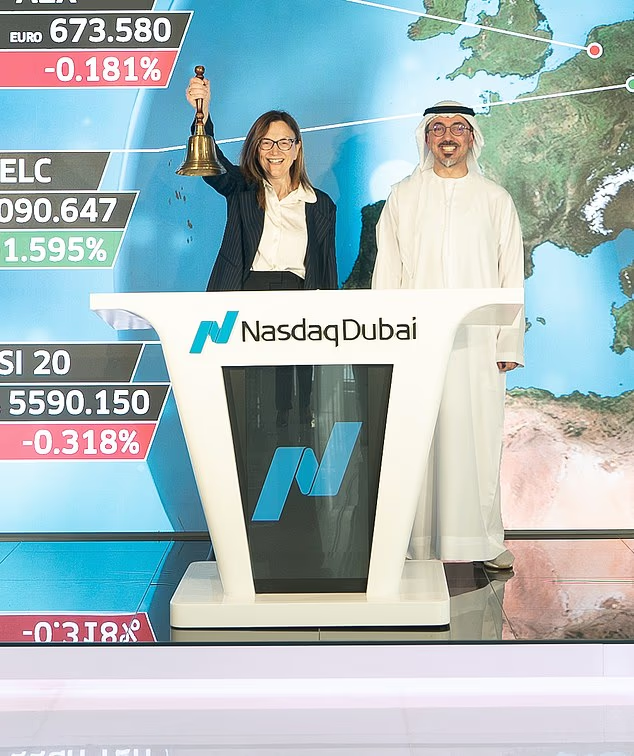
Ruth with Hamed Ali, chief executive of the Dubai Financial Market
Of the 3.4million inhabitants, around nine out of ten are from elsewhere. If large numbers of them head home (because of safety concerns as conflict in the Middle East looms), businesses, and society, would struggle to function.
The property market there has already become much shakier in the past 24 hours, which is worrying for Brits who, according to Sotheby’s, are the second largest group of buyers in Dubai after Indian purchasers.
Part of Dubai’s magnetism is freedom from personal income tax.
In recent months, many high net worth individuals from the UK have gone there to escape Labour’s punitive tax grabs but the rich like to roost in safety.
Tourism, a staple of the economy, will obviously suffer too.
So will its attraction as a location for British businesses. The Dubai Chamber of Commerce previously predicted numbers of UK firms could increase threefold to 15,000 by 2035. Those forecasts may now be wildly optimistic.
The attacks will be a blow to the Dubai Financial Market, whose boss, Hamed Ali, has launched a programme of Thatcher-style privatisations.
Join the debate
Should British expats and investors reconsider their future in Dubai after the missile attacks?

The aftermath of Iran’s strikes on Dubai. Pictured is the Palm Jumeirah Fairmont hotel

A map showing the location of the hotel and where Dubai is in the wider region
So it is impossible to over-state the impact the attacks by Iran have been for the ambitious statelet.
At the vast Expo hosted by Dubai just three years ago, aimed at showcasing its merits to the world, the glorious glitz of it all was overpowering.
The exhibition was sending out a message that Dubai had triumphed over a string of disasters.
These included the property market collapse during the financial crisis of 2008 and the pandemic, which flattened its key industries of airlines, hospitality and high-end retail.
At that time, the director general of Expo, Her Excellency Reem Al Hashimy, told me that Dubai ‘has done so much against all the odds and there is a spirit of defiance’.
She added: ‘As hard as it gets, we will find a way through… There is something very positive about the spirit here.’
Brits who are building their lives and businesses in the emirate will hope that resilience prevails. Whatever happens longer term, this is a violent awakening from the Dubai dream.