
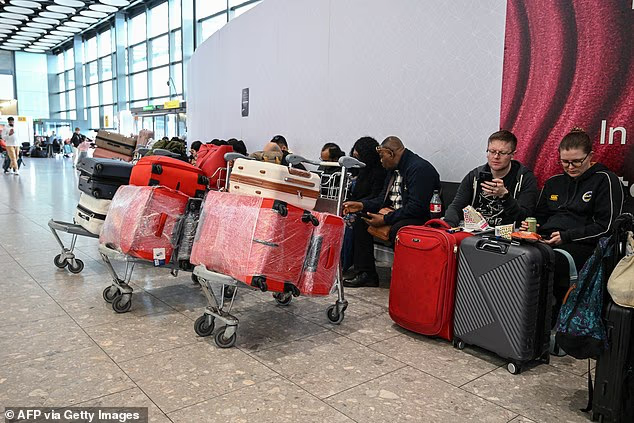
British travellers have been plunged into chaos after Iranian strikes on the Middle East left them stranded in the region or unable to fly to their holiday destinations.
More than 100,000 British citizens are stuck in the Gulf countries, officials say, and thousands more were set to travel there – or through their airports – in the coming days and weeks.
Flights to and from key holiday destinations such as Dubai, Doha and Tel Aviv have been cancelled due to airspace closures. The first flights back to the UK are only just starting to resume.
Airports in these locations are the gateways to Asia and Australia, with thousands of travellers making connecting flights in the region each day.
Travel disruptions have left holidaymakers in the lurch and many have been unable to get back to the UK – or forced to pay for an alternative route home.
So what are your rights if you’re stranded in the Middle East or your upcoming holiday has been ruined – and when are you not protected? Money Mail answers all your questions…
Passengers sit at London Heathrow waiting for news about flights on Sunday
I’m set to travel to the Middle East – what are my rights if my flight is cancelled?
More than 3,400 flights were cancelled as of Monday amid conflict in the Gulf. The Foreign, Commonwealth and Development Office (FCDO) advises against all travel to 15 countries, including Iran, and parts of certain countries, including Egypt and Turkey.
It has also advised against all but essential travel to Bahrain, Kuwait, Qatar and the United Arab Emirates (UAE) as of March 1. Swathes of the Gulf’s airspace have been closed amid the conflict, which has left many airline passengers who have paid thousands of pounds for their trips unable to travel.
If your flight is cancelled, you are entitled to an alternative flight at the earliest opportunity or at a later date if you prefer. Alternatively, you can ask for a refund, according to regulator the Civil Aviation Authority (CAA).
If your airline can’t reroute you via a suitable alternative flight when the airspace opens, you can ask to be booked on a flight with a competitor. If it doesn’t do this then you should call the airline to ask if you can book the alternative flight yourself.
These are rights afforded to travellers from the UK under a regulation called the EU Reg 261/2004, to which the UK still abides.
You are covered if you’re departing from any UK airport to the Middle East and your flight has been impacted, regardless of whether you are flying with a UK, EU or other international airline.
If your flight is cancelled and you no longer want to travel to the Middle East due to the conflict, you can ask for a refund. You should receive it within seven days.
I’m trying to get home from the Middle East but my flight has been cancelled – will I get a refund or compensation?
The level of protection you are afforded depends on which airline you are set to fly to the UK with. If it is an EU or UK airline, such as British Airways, you will be covered under EU Reg 261/2004 rules.
Your airline must get you home and look after you in the meantime by paying for meals and accommodation.
If it cannot offer you this care, you must pay expenses upfront, keep the receipts and hope that you’ll be reimbursed by your airline later.
You should make sure your expenses are reasonable, or your airline may reject your claim. Consumer champion Jane Hawkes says there are not strict definitions of ‘reasonable’. ‘Generally, these costs mean a mid-range hotel rather than luxury accommodation, typically close to the airport and at a standard local room rate,’ she says.
‘If disruption is widespread and prices surge, higher rates can still be reasonable but keep clear evidence. For meals, sensible spending appropriate to the time of day is covered and airlines recognise that airport prices are higher.
‘Fine dining and alcohol are not accepted as reasonable costs. Transport between the airport and hotel should be reimbursed, with public transport preferred where practical, though taxis are reasonable late at night or where no alternative exists.
‘Necessary communication costs, such as phone calls or internet access to rearrange travel, should also be covered.’
Alternatively, you can ask for a refund for your return leg.
However, Tim Riley, who is the chair of the UK Travel Insurance Association (UKTIA) and runs travel insurer True Traveller, stresses that asking for a refund is the last thing you should do.
‘Accepting a refund effectively ends the airline’s duty of care, leaving the traveller responsible for arranging and paying for new flights themselves, which are likely to be significantly more expensive,’ he says.
‘Travel insurance will not cover the difference in cost between a refunded ticket and a new booking.’
Due to airspace closures, you may not be rerouting as soon as you’d like.
If your airline can’t reorganise your flights when airspace opens, you can request that it books you on a flight with a different airline at the earliest opportunity, or ask if you can book an alternative flight and be reimbursed later.
But be aware, these rules do not apply if you are set to arrive in the UK with a non-UK or non-EU airline.
For example, if you booked your return flights with Etihad Airways, you won’t be covered under these regulations. Nonetheless, the CAA still expects airlines to minimise the impact to its passengers.
This doesn’t mean that you aren’t entitled to an alternative flight or a refund, just that you’ll need to speak with your airline to check your rights.
For example, Emirates says passengers can change the date of their ticket to travel on or before March 20 or ask for a refund.
Plus, the UAE and Qatar have said they will pay for the cost of food and accommodation for those stranded in the country.
Unfortunately, you will not be entitled to any additional compensation for the disruptions, the CAA warns.
Under normal circumstances you receive compensation if you arrived at least two hours late or your flight was cancelled less than 14 days before the planned take-off. The amount would depend on when a flight was cancelled, the distance of the flight and the timings of the rescheduled flight.
However, airlines don’t have to pay out compensation if the delay or cancellation is down to ‘extraordinary circumstances’ as we are currently witnessing.
This phrase covers events like political or civil unrest, a security alert, a strike by air traffic control or acts of terrorism.

Cancelled flights to Dubai listed on a display board at an airport yesterday

Grounded planes are seen at the Dubai International Airport following its closure on Sunday
Can I get a refund for my holiday accommodation in the Middle East?
If you booked a package holiday with flights and accommodation and it is cancelled or changed significantly, you must either be offered an alternative holiday at a later date or a refund of the full amount.
Your travel company should contact you if you are in this situation.
Package holiday provider Love Holidays has cancelled all trips to or via impacted areas of the Middle East up until March 8 and it is refunding customers.
If you are stuck on a package holiday, the airline should cover the cost of your accommodation until you can return home – so long as it is a UK or EU airline.
Can I claim on my travel insurance?
Travel insurance is usually the safety net that catches travellers when they can’t get any help from an airline or they need to cancel their hotel booking.
If the reason for the cancellation is outside of an airline’s control, your travel insurer can normally reimburse you for the flight as well as the holiday accommodation and hire car costs.
However, due to the conflict, policyholders may not be able to cancel their trip and claim on their travel insurance as standard policies typically exclude war, hostile acts, civil war and military action.
This is because these events cannot be priced into policies.
Ms Hawkes explains: ‘Policies vary widely so, when sorting travel insurance, ensure that you take out the most comprehensive cover possible as soon as you book your holiday.
‘It is not just a simple box-ticking exercise. General exclusions on polices include adverse weather, force majeures, missed departures and war or civil unrest.
‘Always check small print carefully to see what you are and are not covered for.’
Some policies may allow you to claim if the advice from the FCDO about travel to the region changed with 31 days of travel.
If you travel against the advice of the FCDO, your travel insurance may be invalidated. For example, the body has advised against all but essential travel to the UAE.
I’m set to travel soon but now I feel uncomfortable – can I cancel and rebook my flight for a different time?
Many holidaygoers may still feel wary about travelling to the Middle East in the coming days and weeks, even if the conflict subsides.
But this is unlikely to be a valid enough reason to get a refund on an upcoming trip.
If your upcoming flight has already been cancelled due to the conflict, you can choose a refund instead. This should arrive within seven days.
However, if the flight is still going ahead, it’s unlikely you’ll be reimbursed if you cancel it. Ms Hawkes says that if the trip is still operating and you choose to cancel for personal reasons, you may not have a legal right to a refund.
She says: ‘If you’ve got a Dubai holiday booked for just a few weeks’ time, for example, start by checking the latest Foreign Office advice and your airline’s position. If flights are operating and there is no change in official advice, your trip may still go ahead as planned.’
Official advice from the FCDO is currently not to go to the United Arab Emirates except for essential travel. But keep an eye on this nearer to your trip as it may change.
‘Disinclination to travel is not a valid reason for a refund. But try to contact your provider to ask about flexibility, date changes or waivers, as many companies offer goodwill options during periods of uncertainty. Avoid cancelling immediately without understanding your rights.’
Many airlines are offering passengers the chance to cancel or rebook their flights in the coming days, even those not covered under the EU regulations.
For example, Quatar Airways says that if you are travelling between February 28 and March 10, you can push forward the date of your flight by up to 14 days or you can get a refund.
British Airways customers set to travel between London Heathrow and Abu Dhabi Amman, Bahrain, Doha, Dubai or Tel Aviv up to March 15 can change their flight date to any time before the end of March 29. Customers travelling before March 8 can also request a refund.
Check options with your airline.

A satellite image shows smoke billowing from the Jebel Ali port in Dubai following an Iranian missile attack on Sunday

Stranded passengers head to Dubai’s airport in the hope of catching a flight home, as limited flights resume
I’m visiting another country but my flight stops over at Doha – what will happen?
Many international flights, such as those to and from Australia and Asian countries such as Thailand or Pakistan, have stopovers in the Middle East in places such as Doha.
But these may now be cancelled or changed due to the conflict.
For example, you may now have been rerouted via a direct flight or have a different stop over destination.
This may mean your arrival is delayed.
However, you will not be eligible for compensation as you would in normal times under EU and UK rules, because the delay is driven by ‘extraordinary circumstances’.
If your flight is cancelled, you may be entitled to a refund or an alternative flight.
Am I covered for indirect expenses I clock up?
Because the current disruption is caused by war, though, neither travel insurers nor airlines need pay for what is known as consequential losses.
That means that if you’ve paid for a hotel and don’t use it, or for car rental you can’t redeem, or for pet sitting while you’re away, you won’t be reimbursed.
Travel insurance also won’t pay out for loss of earnings if you can’t work because you’re stuck in the Middle East.
What if I don’t get what I’m owed?
If your airline rejects your claim, you can try to use Alternative Dispute Resolution to resolve the matter. In the UK, two approved ADR schemes cover aviation: AviationADR and CEDR, and there’s a list of the airlines signed up with each scheme on the Civil Aviation Authority website (caa.co.uk).
If your airline is not signed up with either – and this includes many Middle East airlines such as Qatar and Etihad – then the CAA’s own team can consider your complaint.
Have your travel plans been disrupted? moneymail@dailymail.co.uk