
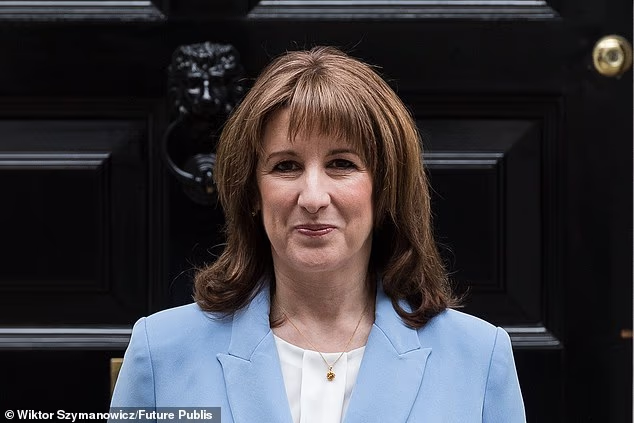
The Chancellor delivered her Spring Statement this afternoon, against the backdrop of an escalating conflict across the Middle East.
Rachel Reeves claimed her growth plan was working, taking credit for falling inflation and lower interest rates.
She told MPs: ‘This Government has the right economic plan for our country, a plan that is even more important in a world that in the last few days has become yet more uncertain.’
She added: ‘The new forecasts from the Office for Budget Responsibility (OBR) confirm that our plan is the right one – inflation is down, borrowing is down, living standards are up and the economy is growing.’
But the OBR downgraded growth expectations for the year and warned that the UK could face a ‘significant’ hit from the war in Iran.
Rachel Reeves said her growth plan was working, but watchdog OBR downgraded this year’s forecast
Elsewhere, it gave predictions on where unemployment, inflation and interest rates will be, but all of these were made before US and Israel launched attacks on Iran over the weekend.
The Budget watchdog highlighted that conflict in the Middle East ‘could have very significant impacts on the global and UK economies.’
Economists predict that if the conflict persists, energy prices will start to rise again, which will push the overall inflation figure higher. Similarly, it could weigh on GDP growth if uncertainty continues.
This is Money highlights the key data from the OBR’s latest projections and how the outlook has changed.
1. GDP growth for 2026 downgraded
The OBR downgraded its GDP growth forecast for this year and now expects it to slow from 1.4 per cent in 2025 to 1.1 per cent in 2026.
The OBR said it reflected ‘weaker-than-expected GDP outturns in late 2025’, a loosening labour market and subdued business surveys.
It’s expected to pick up again over the medium term, the watchdog said, to an average 1.6 per cent a year from 2027 to 2030 as productivity growth rises.
The OBR’s forecast for real GDP per person, which reflects changes in the average standards of living, is marginally higher than in November. It is expected to grow at an average rate of 1.1 per cent a year between 2026 and 2030.

2. Unemployment to rise further
The OBR expects the unemployment rate to peak at 5.3 per cent this year as people struggle to find work ‘amid subdued hiring demand’.
This is a third of a percentage point higher than the watchdog’s November forecast, and recent figures from the Office for National Statistics (ONS) show the jobless rate has already reached 5.2 per cent.
The OBR expects weakness in the market to continue ‘in the near term’ before falling ‘gradually’ to 4.1 per cent by 2030.
Wage growth is expected to slow to around 3.5 per cent this year, and then 2.25 per cent a year, broadly in line with November’s forecast. But the OBR highlighted that this would depend on how firms manage costs, ‘including from minimum wage increases and tax and regulatory changes.’

3. Public sector net borrowing will fall faster
Borrowing is set to be £132.7billion, £6billion lower than the OBR forecast in November. It has also been revised down slightly in the medium-term, hitting £63.4billion in 2029/30, down £4billion from the previous forecast.
And it has been revised down by £8billion in 2030/31, due to an improved tax receipt forecast.
Public sector net borrowing is forecast to fall from 5.2 per cent of GDP in 2024/25 to 4.3 per cent of GDP this year, at a slightly faster pace of decline than expected in November.
Debt is expected to be broadly stable over the period, said the OBR, settling at a projected 95 per cent of GDP by the early 2030s, marginally lower than originally forecast.

4. Inflation to fall but Iran conflict complicates matters
The OBR projects inflation to fall from an average 3.4 per cent in 2025 to 2.3 per cent in 2026, and 2 per cent from 2027 onwards.
The OBR says that the fall in the headline rate of inflation will be driven by lower food and energy prices. But experts are already warning that these forecasts are out of date due to the escalating conflict across the Middle East, which has sent oil and gas prices soaring.
A sustained hike in gas prices could easily feed through to consumer’s energy bills, which would add to the overall inflation rate.
All of this will have an impact on how quickly the Bank of England will cut the bank rate. While the OBR expects it to be cut to 3.3 per cent by late 2026, markets have trimmed their bets for a widely-expected cut this month from 80 per cent to 30 per cent.

5. Tax take continues to rise on frozen thresholds
Tax receipts as a share of GDP will rise by more than expected in the medium term, as the tax burden reaches its highest level, helping to steady borrowing figures.
The OBR said that the total tax take will increase from 34.5 per cent of GDP in 2024/25 to a peak of 38.5 per cent by 2030/31,’a historic high’ following previous announcements by the Chancellor.
Frozen income tax thresholds and the increase in employer National Insurance contributions are the main drivers of this.
The OBR also said that it expects to see a rise in the amount taken by inheritance and capital gains tax following changes announced in the 2024 Budget.
While the outlook is broadly unchanged from November’s forecast, there is a 0.2 percentage point growth by 2030/31, ‘primarily due to stronger-than-expected equity price growth since November’.
As with inflation, these forecasts could soon be wildly out of date as stock markets tumble in the face of tariff uncertainty and the escalation of conflict in the Middle East.

DIY INVESTING PLATFORMS
AJ Bell
AJ Bell
Easy investing and ready-made portfolios
Hargreaves Lansdown
Hargreaves Lansdown
Free fund dealing and investment ideas

interactive investor
interactive investor
Flat-fee investing from £4.99 per month

Freetrade
Freetrade
Investing Isa now free on basic plan

Trading 212
Trading 212
Free share dealing and no account fee
Affiliate links: If you take out a product This is Money may earn a commission. These deals are chosen by our editorial team, as we think they are worth highlighting. This does not affect our editorial independence.
Compare the best investing account for you