
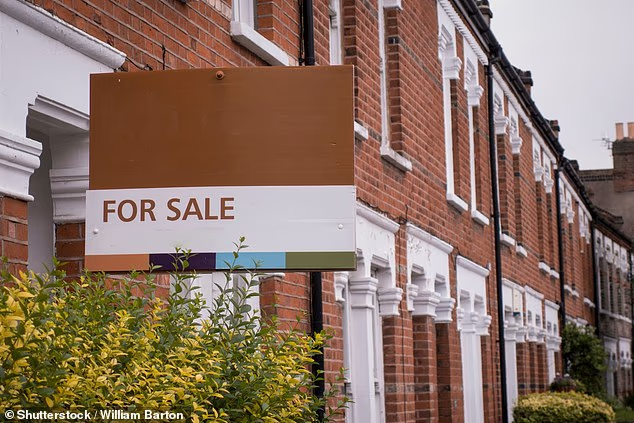
House prices grew 1 per cent in the year to February in a ‘modest recovery’, Nationwide Building Society data shows.
Homeowners saw values grow 0.3 per cent from January to February as the market recovers after the stagnation before the Budget in November.
Prices were up from £270,873 to £273,176 last month, the report reveals.
Robert Gardner, chief economist at the mutual, says: ‘This reinforces the view of a modest recovery after a dip at the end of 2025, most likely reflecting uncertainty around potential property tax changes ahead of the Budget.
‘Nevertheless, the number of mortgages approved for house purchase remain close to the levels prevailing before the pandemic.’
‘Modest recovery’: Prices grew 0.3% in February as market starts to recover post Budget
Despite such a modest rise, this is the highest house prices have been since May 2025, before Budget rumours started to circulate.
Uncertainty over housing policy in Chancellor Rachel Reeves’ second Budget caused the market to stall last year.
Fears of tax changes caused would-be buyers to sit on their hands as confidence plummeted.
This is turn caused a slowdown in the market and prices were lukewarm amid the uncertainty.
Plus, stretched affordability and a hike to the stamp duty that must be paid when purchasing a home meant many prospective buyers decided to wait for better market conditions before making their home move.
But in the months since the Budget, the market is showing signs of subtle recovery.
Alice Haine, of investment platform Bestinvest, says: ‘The rebound in activity is largely driven by a surge of sellers listing their homes, with 6 per cent more homes on the market than a year ago.
‘This increase points to improving confidence as more homeowners look seek to capitalise on strengthening conditions to move, including more competitive mortgage rates and the widest choice of low-deposit mortgages for first-time buyers in almost two decades.’
Will mortgage rates be hit by conflict?
Mortgage rates have been falling, which may have lured many buyers to the table as their borrowing costs will now be lower.
‘Buyer confidence has been low in recent years, but an improving rate outlook could see demand, and subsequently house prices, pick back up.’
However, experts are warning that conflict in the Middle East could see the improving housing market turned on its head.
Babek Ismayil, chief executive of homebuying platform OneDome, said inflation could rise again due to the Middle East crisis.
He explains: ‘Mortgage rates have also been edging down this year as lenders priced in the likelihood of further rate cuts but clearly events in the Middle East over the weekend could prove inflationary and now delay any cuts. It’s currently a very fluid situation.’
Andrew Montlake, of broker Coreco, agrees. He says: ‘Prices rose slightly in February but that could turn quite quickly after this weekend’s events in the Middle East.
‘The impact on the UK economy could be profound.
‘Domestically, more rate cuts this year by the Bank of England were priced in but this now looks far less likely as oil prices are already headed north and could potentially rise sharply.
‘There is every chance swaps will start to move up on Monday, which will be a blow to borrowers.
‘The UK economy and property market, which so desperately needs a rate cut or two, may now have to wait longer. Expect a turbulent week ahead.’