
‘Don’t panic’ is the message to investors as markets turn a sea of red while the Iran conflict seizes the Middle East.
Investors with a well-balanced portfolio and a long-term strategy should as a rule sit tight in times of global crisis.
The keep calm message holds even during market upheaval caused by seismic events like the US and Israel’s attack on Iran.
It is always worth reviewing your holdings to ensure they are sufficiently diversified to withstand a likely series of short-term shocks to the financial system.
But in most cases that still means sticking to a hands-off approach, although some investors might want to back off from certain riskier sectors, while the more adventurous may even seek opportunities amid volatile markets.
So far oil and gold prices have surged while stocks have fallen, but the London market has been sheltered to an extent by its exposure to energy, mining and defence stocks.
Banks and travel stocks have so far borne the brunt of the selling due to the immediate impact of war in the Middle East, which for now has no end in sight.
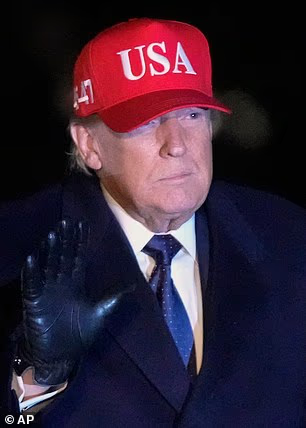
US president Donald Trump arrives on Marine One on the South Lawn of the White House in Washington on Sunday
‘The best offense in times of uncertainty is defence and keeping overall market exposure modest,’ says Saxo’s global head of macro strategy, John Hardy.
‘For the nimble, an added approach is to keep some cash on hand to deploy once clarity emerges.
‘It is also important not to panic and over-correct – spikes of uncertainty can resolve very quickly if the disruption clears.’
But Daniela Hathorn, senior market analyst at Capital.com, says: ‘With Washington signalling that operations could continue for weeks, markets are confronting an open-ended conflict rather than a brief exchange.
‘Financial markets struggle to price scenarios where the potential outcomes range from rapid containment to broader regional conflict.
‘That uncertainty alone is enough to elevate volatility and encourage risk aversion, even before any measurable economic damage materialises.’
Below we look at some of the biggest market moves today and the likely effect on investment portfolios. But again, for most investors in it for the long haul the message is very much ‘wait and see’ during what could be still the early days of this conflict.
Gold price surges
Gold has risen to around $5,400 but is still trading short of its all-time record of around $5,600 just over a month ago.
The rush into gold will come as little surprise. The precious metal is a store of wealth and hedge against inflation, a useful way to diversify and a safe haven asset during financial and political upsets.
Most investors will have at least some gold already in their portfolio, whether as insurance or from seizing earlier opportunities during its recent stunning surge in value – it was trading at less than $3,000 an ounce a year ago.
The main ways to hold gold are via investment funds, whether specialist or multi-asset, mining stocks, physical bars and coins, and Exchange Traded Commodities (ETCs).
BullionVault says it saw record weekend demand for gold after the US-Israeli attack on Iran.
‘Weekend gold demand typically runs to around 15 per cent of the average week-day,’ says director of research Adrian Ash.
‘It’s a measure of how seriously investors view this new Middle East war that Saturday and Sunday saw gross demand for gold jump by 187 per cent compared to the previous five days’ level.’

Airstrikes against Iran: Uncertainty over whether conflict will be short and contained or intensify across Middle East
Oil and energy stocks
Most UK investors will have exposure to the oil giants of the FTSE 100, BP and Shell – both among the top risers on the board today – and other commodity stocks on the London market.
‘From a markets perspective, the central issue is energy,’ says Daniela Hathorn of Capital.com.
‘Iran sits at the heart of the global oil supply chain, both as a producer and through its geographic proximity to the Strait of Hormuz, a chokepoint through which a significant portion of global oil shipments pass.’
She says any sustained disruption could quickly evolve into a broader supply shock, while secondary risks include shipping slowdowns and potential disruptions to global trade flows and aviation routes.
‘If the conflict expands or persists, the inflationary consequences could ripple through the global economy,’ she adds. ‘Equity markets, particularly in countries heavily reliant on energy imports such as Japan, China and India, face downside pressure as higher input costs threaten growth.’
Airlines and other stocks
Airline, hotel and other travel stocks throng the fallers’ board today, but markets typically price in the worst case scenario when a war is making headlines.
These are sectors which can snap back quickly if tensions subside, or as people who want or need to get around the world adjust to a ‘new normal’, albeit one that may look riskier for some time.
Lauren Hyslop, fund manager at Mattioli Woods, says: ‘So far, the immediate market response follows a well-worn script: oil and energy prices up, equities broadly lower, gold firmer, the dollar stronger. Defence stocks will find admirers; airlines and manufacturers will not.
‘A swift de-escalation would allow markets to shake off the initial losses with relative ease. Prolonged disruption to shipping and insurance, the more plausible near-term outcome, keeps energy prices elevated and sentiment fragile.’
Hyslop says a wider regional conflict is the tail risk nobody wishes to price but that prudent investors must at least acknowledge, and the key variable is time.
‘Short-term shocks are digestible. It is the ones that linger that reshape portfolios and economies.’

White House: Investors usually rush into US government bonds as a safe haven but experts see signs they might prove less credible in the role this time
Government bonds
Governments around the world issue bonds in order to borrow money to help pay their bills. Investors, including banks, insurers and pension funds as well as individuals, buy them in order to earn a return.
They are a classic safe haven asset so should do well in the near term, though there are signs of trouble in the behemoth US treasuries market that everyone will be watching most closely.
The highest-rated lowest-risk government bonds with lots of liquidity, such as those issued by the US and UK, are likely to be in demand so we should see yields fall, says Emma Wall, chief investment strategist at Hargreaves Lansdown.
But she warns that for the US in particular, yields may become less predictable as time goes on.
‘While it is not the base case, should this war become protracted, and there is a requirement for increased military spending and an increased risk of inflation, expect prices to flip and yields to rise and the dollar to weaken.’
John Hardy, of Saxo, says US treasury yields closed Friday on a strong note, perhaps in anticipation of the risk of a conflict, but notes that they are already slightly higher today. He says this is a stunning change relative to prior cycles when US treasuries were nearly universally considered the safe haven asset of choice.
‘Some could argue that high oil prices will also spike inflation and therefore prevent the Federal Reserve from cutting [interest rates] as much, but economic weakness and the labour market are greater threats if big spike in oil prices is sustained.
‘I think it is more of a signal that the world doesn’t see US treasuries as a credible safe haven any longer.’
Daniel Casali, chief investment strategist at Evelyn Partners, says investors can seek protection in inflation-linked bonds, such as TIPS – Treasury Inflation-Protected Securities – should higher crude oil prices feed into inflation expectations.
Overall, he expects markets to remain volatile in the days ahead, with news flow intense and at times sensational.
‘It is important to distinguish between media tone and market fundamentals. At this stage, this is not a systemic market event. We are not seeing disorderly trading conditions or liquidity stress.
‘For now, the appropriate stance for investors is calm, disciplined and long-term. Periods of geopolitical tension are unsettling, but diversified portfolios are designed to navigate precisely these environments.’
DIY INVESTING PLATFORMS

AJ Bell
AJ Bell
Easy investing and ready-made portfolios
Hargreaves Lansdown
Hargreaves Lansdown
Free fund dealing and investment ideas

interactive investor
interactive investor
Flat-fee investing from £4.99 per month

Freetrade
Freetrade
Investing Isa now free on basic plan

Trading 212
Trading 212
Free share dealing and no account fee
Affiliate links: If you take out a product This is Money may earn a commission. These deals are chosen by our editorial team, as we think they are worth highlighting. This does not affect our editorial independence.
Compare the best investing account for you