
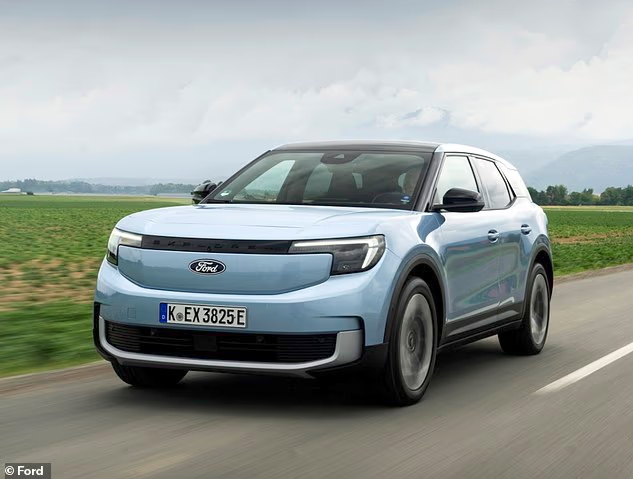
Ford has proven that life saving inventions can come from the most unlikely inspiration sources.
The American car giant has introduced a new airbag design in two of its electric cars that it claims has been inspired by whipped cream canisters.
Its ‘groundbreaking’ new centre side airbag technology aims to mitigate injuries sustained in side-impact collisions which account for a quarter of all crashes.
Like the cheap dessert cans, the airbag uses a cold gas inflation system to deliver rapid inflation while avoiding the high temperatures that can occur with airbag deployment.
This differs from traditional airbags which use a pyrotechnic charge that generates gas to inflate the bag.
The innovative airbag has been introduced in Ford Explorer and Capri EVs and has already helped the Explorer earn a five-star safety rating from safety body Euro NCAP.
Ford has introduced groundbreaking new side airbag technology inspired by whipped cream canisters into its Exploer and Capri EVs. It works to reduce side-impact collisions
Ford engineers developed the cold gas inflation system to allow side airbags to deploy at much lower temperatures while still delivering the rapid inflation needed to protect passengers in milliseconds.
To create the whipped cream airbag, Ford’s safety engineers worked with a supplier that began by creating gas canisters for whipped cream.
Christian Giesen, a vehicle safety engineer at Ford of Europe, said: ‘At Ford, we are always looking for creative solutions to make our vehicles even safer.
‘This new centre side airbag is a perfect example of that ethos. By rethinking the technology, we were able to add a significant layer of protection for our customers.
‘The fact that we found inspiration in a whipped cream can shows that great ideas can come from anywhere.’
As one of the oldest car manufacturers in the world, Ford has pioneered many safety innovations over the years that have become industry standards.
These include the introduction of safety glass in 1927 to being one of the first car makers to make anti-lock brakes standard in 1985.
Why side-impact collisions pose a high injury risk
Side-impact collisions carry significant risk even at low speeds.
This is because there’s minimal space between the impact point and the occupant, which means there’s less crush zone to absorb the crash energy compared to a front or rear collision.
It can result in greater forces being transferred to the occupants – a key reason why head and chest trauma is the leading cause of life-threatening injuries in these events.
Side impacts account for 35-40 per cent of all serious and fatal passenger injuries in the EU. And nearly half of those injuries occur on the far side of the vehicle from the crash.
As such, Ford says that ‘innovations in occupant protection are more crucial than ever’.

Volvo’s new ‘super seatbelt’ is a new ‘multi-adaptive safety belt’ that can measure an occupant’s body
It’s not the only innovative safety tech coming in 2026
Ford isn’t the only one using innovation to keep people safe in 2026.
Volvo is reinventing the setabelt – one of the oldest and most effective safety features that dates back 65 years.
The Swedish car brand unveiled its new ‘super seatbelt’ in June 2025 – an evolution of the three-point seatbelt it invented and has been used in cars since 1959.
It will be first available in the new EX60 SUV – the brand’s new family car that boasts the longest full-charge range of any electric vehicle at 503 miles.
The new ‘multi-adaptive safety belt’ improves protection levels by using sensors that analyse the height, weight, body shape and seating position of an individual.