
Jump to winners | Jump to methodology
The tallest poppies
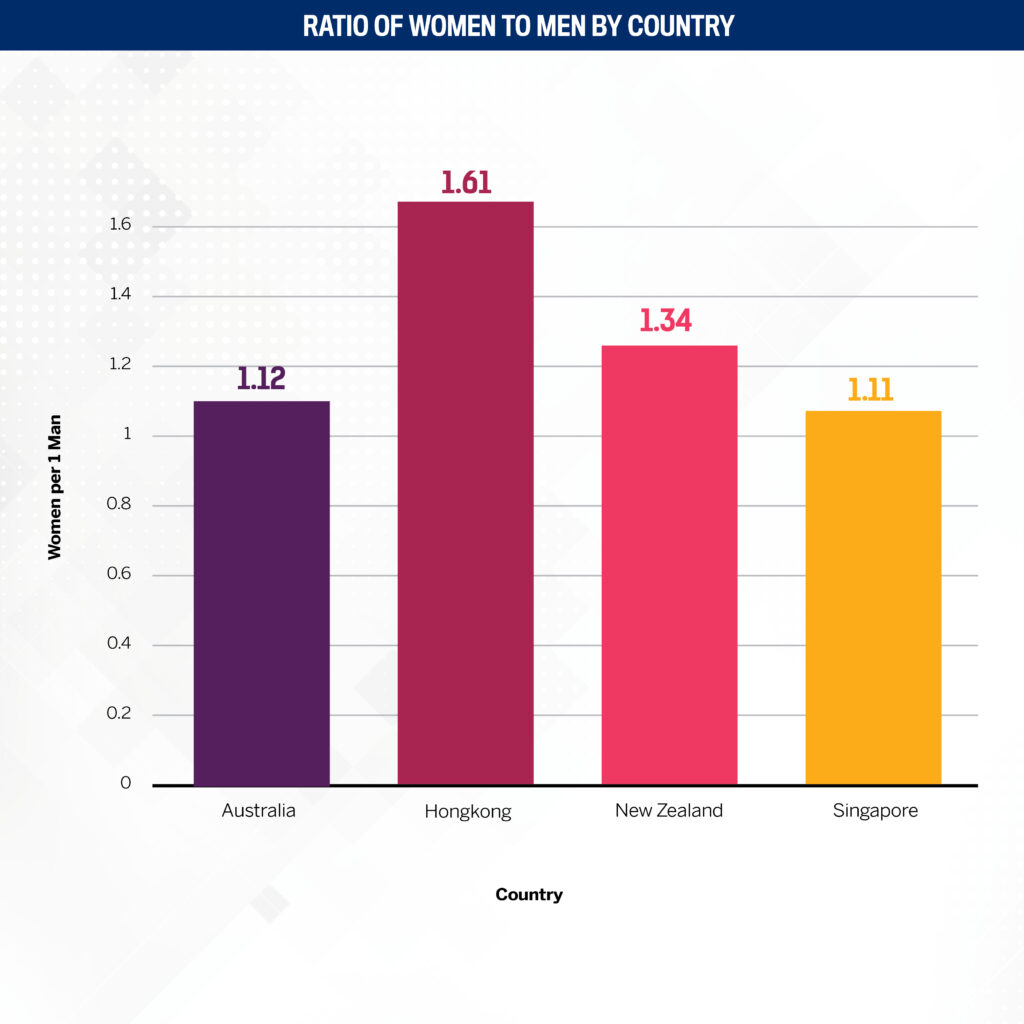
As with other matters, everything is not what it seems in the Asia-Pacific insurance industry. In a pure numbers game, women lead the way, and the data shows that women’s share of the financial and insurance services workforce is healthy.
-
Australia – 183, 192 women to 163,058 men
-
Hong Kong – 40,000 women to 24,800 men
-
New Zealand – 41,000 women to 30,500 men
-
Singapore – 123,600 women to 111,700 men
Yet leadership and pay statistics tell a different story. Jean Pierre Hung, managing director of Singapore-based LMA Recruitment, labels this ‘pipeline leakage’. He says, “In many Asian markets, women account for around 50–58% of the workforce at entry and mid-levels, often outperforming other regions and industries at these stages. Where APAC clearly lags is at the top of the organisation.”
There is some progress due to industry networks and formal development programs making a difference in certain markets, such as Australia and Singapore.
Even so, Gallagher Bassett’s general manager for Victoria, Stephanie Connolly, stresses that parity remains elusive. “There is still work to be done in APAC to build women’s influence and decision-making power, particularly at the executive and board levels,” she says.
Insurance Business’ Elite Women 2026 report recognises 70 top female professionals who have shaped and influenced the industry with high-calibre performance, strategic vision and leadership rooted in integrity and empathy. Almost all the winners occupy high-impact decision-making roles and are agenda setters, with key leadership roles in underwriting, distribution and corporate functions.

This year’s Elite Women are concentrated in Australasia, signalling the region’s strong bench of female insurance leaders. A smaller but notable presence in Singapore reflects its role as a regional hub where a select group of women is shaping APAC and global strategies.

With tenures averaging 20 years, this cohort boasts deep-level expertise. Their career progression shows how women have had to stay the course over decades to reach senior roles, bringing rich market, risk and client insight to their organisations.

Elite Women of 2026’s expert industry views
Behind the headline numbers, this year’s winners describe an industry in transition. These insights are drawn from IB’s survey of female insurance professionals across Asia, Australia and New Zealand. For many of these elite leaders, the challenge sits less in their technical work and more in the structures, perceptions and expectations.
IB: Is there a lack of women leaders for younger women to look up to and aspire to follow in their footsteps within the industry?
Survey consensus:
-
Around two-thirds say there is still a shortage of women in senior roles for younger women to aspire to.
-
Despite progress on overall participation, visibility and representation at the very top continue to lag, reinforcing the ‘pipeline leakage’ highlighted in broader market data.
IB: Do you feel you would have achieved more in terms of seniority or responsibility if you were not female?
Survey consensus:
-
Just under half believe they would have attained greater seniority or responsibility if they were not female.
-
Even within this high-performing cohort, a sizeable share see gender as a drag on career progression, underlining the persistence of structural and cultural barriers.
IB: Does your firm have any policies regarding equal pay for the same roles regardless of gender?
Survey consensus:
-
More than eight in 10 say their firms have formal equal pay policies for the same roles regardless of gender.
-
Policy coverage in this group’s organisations looks relatively strong, but ongoing pay gaps across APAC suggest that intent does not automatically translate into equitable outcomes without robust measurement and accountability.
IB: What is the most difficult thing about being a woman in the insurance industry?
Survey comments:
-
“The hardest part isn’t the technical work – it’s constantly having to prove my credibility in rooms that are still dominated by men”
-
“I often feel I need to work twice as hard as my male peers just to be seen at the same level”
-
“I would find people not trusting my advice yet accepting it immediately when it came from a male colleague. Many would assume that I was an assistant simply because I am a woman”
-
“There are still so few women in senior broking and underwriting roles. You end up being the only woman at the table and carrying the pressure of representing all of us”
-
“Imposter syndrome is a constant undercurrent. You feel you have to be perfect to justify your place, while walking a tightrope between being ‘too soft’ and ‘too aggressive’”
-
“Senior women are expected to mentor, champion DEI and hold the culture together, on top of full P&L and leadership responsibilities. That emotional load is rarely recognised”
2026 Elite Women profiles
Chief Investment Officer
Sustainability is at the heart of Liu Chunyen’s leadership, and she considers the summer 2025 launch of AIA Singapore’s first-ever Sustainability Report 2024 a career-defining moment.
“The report captured our sustainability journey and reinforced how its principles are integrated across our operations, strengthening our commitment as a responsible corporate citizen,” she says.


“What I’m proudest of is seeing sustainability evolve from a compliance requirement into a strategic mindset across the organisation”
Liu ChunyenAIA Singapore
The report marked a major milestone for AIA Singapore and earned them:
-
Bronze award for Asia’s Best Sustainability Report (First Time) at the Asia Sustainability Reporting Awards (ASRA) 2025
-
Finalist in Asia’s Best in Workplace Reporting
Under Chunyen’s leadership, sustainability governance now acts as a strategic enabler in the insurer’s portfolio construction, capital allocation and enterprise strategy. This is evident in AIA’s Sustainable Multi-Thematic Fund, a bespoke thematic strategy targeting long-term challenges like climate change by offering solutions that mitigate investment risks while generating positive environmental and social outcomes.

Chunyen hopes that this initiative demonstrates “that sustainable investing and long-term financial performance can be mutually reinforcing, not mutually exclusive.”
As a leader operating at the intersection of capital, climate and social wellbeing, Chunyen is deliberate about balancing profit and purpose. She says, “When evaluating a major allocation, I often ask, ‘What legacy will this capital leave for the communities we serve?’ Most focus on returns or market trends, which are essential. I take it a step further and consider how an investment can solve global challenges like climate change and the impact it has on the wellbeing of our customers, employees and communities.”
Chief Executive Officer
If AIA Singapore’s first female CEO had to sum up her leadership brand, it starts with a simple mandate of ‘putting people first’.
“My vision for the company goes beyond profit – it’s about empowering our people and serving our customers in ways that create real, meaningful impact,” Wong Sze Keed says.
That principle is embedded in how she runs both the business and its people agenda. Internally, she has supported capability, wellbeing and inclusion through:
-
partnering with Singapore Airlines Academy on a curated talent program for all AIA Singapore employees
-
driving continuous upskilling through partnerships with the Wealth Management Institute of Nanyang Technological University to help personal wealth managers match the expertise of private bankers
-
leading an executive committee mentorship program that gives high-potential talent direct access to senior leadership
“Programs like this bridge the gap between potential and opportunity by providing guidance, visibility and support for employees to step confidently into senior positions,” Sze Keed explains. “We are proud to have built one of the most gender-balanced leadership teams with women holding 40% of senior leadership positions in an industry where women typically represent only around 20% of C-suite roles.”

“What will define the next generation of women leaders in this industry is the ability to lead with empathy. The real challenge isn’t choosing between empathy and business outcomes but ensuring they work in tandem”
Wong Sze KeedAIA Singapore
Sze Keed’s people-first philosophy is just as visible in AIA Singapore’s propositions. Under her leadership, the insurer has:
-
set a new market standard by automatically including inpatient mental health coverage in inpatient plans at no extra premium, extending support to over 1.3 million employees
-
launched AIA+, a holistic health and wealth ‘super app’ that integrates insurance, finance, healthcare and wellness in one platform, supported by AIA Vitality to reward healthier client behaviours
-
provided over 1 million members with affordable telemedicine, health screenings and pediatric care, making quality healthcare more accessible
-
partnered with Amplify Health to launch the Chronic Disease Management Programme (CDMP), a mobile app that supports people with chronic conditions like diabetes and high blood pressure to adopt sustainable lifestyle changes
-
closed critical illness protection gaps with first-in-market solutions like AIA Ultimate Critical Cover
The impact of Sze Keed’s leadership is seen in AIA Singapore’s recent milestones:
-
5% value of new business growth for the full year of 2024, supported by double-digit growth across all distribution channels
-
Best Employee Insurance Provider of the Year (GOLD) for 19 consecutive years at the HR Vendors of the Year 2024
-
#1 MDRT Company for the 11th consecutive year in 2025, recording the highest number of MDRT members
As president of Life Association Singapore, Sze Keed is also laser-focused on a bigger system shift she believes the region needs to make.
“Our industry now has a unique opportunity to evolve from being merely a safety net to an active partner in people’s lives – supporting early intervention, holistic health and financial wellbeing, rather than focusing solely on treatment and claims,” she says.
What makes an Elite Woman in 2026?
Five common themes emerged from the winning group. Across markets and specialisms, the 2026 Elite Women combine senior responsibility with innovation, people leadership, commitment to diversity and a strong sense of social purpose.
Deep experience and senior responsibility
They are not emerging leaders; they are running critical parts of the APAC insurance ecosystem.
-
One nominee is described as “one of the few women leading a major insurer in Australia,” promoted to CEO after a 17-year track record of expertise, commercial orientation, relationships and leadership reputation. As country CEO, she now sets strategy and leads a full national P&L.
-
Another winner, a managing director and co-founder of a major underwriting agency, “built the business from the ground up,” starting with a single binder agreement and growing it into a multi-division enterprise with over 50 staff before leading its sale and full rebrand to a global MGA in 2025.
Collectively, these leaders hold CEO, COO, CIO and general counsel and equivalent roles or run key portfolios, bringing close to two decades or more of industry experience to the table.
Trailblazers and innovation leaders
What distinguishes this cohort is not only seniority but also how often they are trusted to lead high-stakes change.
-
A senior casualty underwriter is credited with developing a peer review system that reduced leadership pressure, surfaced skills gaps and helped build a general liability rating system alongside a current project to bring manufacturing risks onto an online platform to improve accessibility.
-
A lead platform engineer is praised for steering teams through complex technical challenges while reshaping business priorities and strengthening her firm’s security posture through a technology and delivery maturity uplift.
For recruitment expert Hung, performance with purpose, for example, driving growth in new products, modernising customer journeys through digital transformations and leadership through periods of disruption are the hallmarks of an Elite Woman.
He adds, “Their impact is visible both commercially and, in the experience, delivered to customers.”
Culture builders and mentors
They stand out for how they develop people and shape inclusive cultures.
-
A New Zealand head of affinity is recognised for dedicating her time to mentoring new employees and younger professionals and for actively promoting insurance as a viable and rewarding career option for school leavers.
-
A director of a multi-awarded brokerage is described as leading a predominantly female team and using her committee role in a women’s enterprise organisation to host initiatives like Women in Wealth events.
Gallagher Bassett’s Connolly adds how the impact of women supporting women cannot be overstated. She says, “When women leaders champion rising female talent and visibly support diversity and inclusion policies, they open doors for others and help challenge organisational culture.”
Diversity, equity and inclusion champions
Many of this year’s Elite Women use their positions to push for more equitable workplaces and markets.
-
One general manager has helped found South Australia’s first women-in-insurance peer network. She also mentors emerging female leaders, challenges bias in hiring and promotion and makes senior female leadership more visible.
-
One COO reviewed pay practices, closed gender gaps and redesigned parental leave to include superannuation coverage so women are not penalised long term, driving structural change instead of relying on one-off initiatives.
Community and social impact beyond insurance
A striking share of winners extends their leadership beyond their jobs, using their influence for wider social impact.
-
One regional COO is a regular participant in the Vinnies CEO Sleepout, with her 2025 fundraising team raising over $1 million to support people experiencing homelessness.
-
Another COO has long-term involvement with You Matter, a charity that supports women and children affected by family violence by providing and setting up essential household items for safe, long-term accommodation.
Gender pay gaps across APAC
Australia remains entrenched
The Workplace Gender Equality Agency’s (WGEA) report shows an average total remuneration gender gap of 21.1%. For every dollar a man makes, a woman earns 79 cents, adding up to a difference of $28,356 in a year.
KPMG Australia’s She’s Price(d)less report, produced with the Diversity Council Australia (DCA) and WGEA, finds that women earn an average of $42.26 per hour compared to $45.57 for men – an hourly gap of 7.3%, up from 6.5% in 2020. At the current pace, closing the gender pay gap will take more than 25 years.
Leadership representation remains similarly weighted. WGEA data shows that while gender-balanced boards are becoming more common, men are still twice as likely as women to sit on governing bodies.

New Zealand’s picture is mixed
The national gender pay gap fell to 5.2% in 2025 from 8.2% in 2024, but within financial services, the gap remains high at 23%.
MoneyHub’s analysis of Stats NZ data shows the overall gender pay gap narrowed to 16% in 2025, down from 25.5% in 2010, but it varies significantly by life stage. Employees aged 25 to 29 record the smallest gap at 7.7%, while the widest gap, 20.9%, is among employees aged 50 to 54. This coincides with the years when many women reduce hours for caregiving, which the report terms as the manifestation of the ‘motherhood penalty.’

In governance, women hold 31% of director positions across NZX-listed companies, including 36.4% of S&P/NZX50 directorships. In the financials sector, female directors account for 32% versus 68% for men.
Connolly notes that mature markets, including Australia and New Zealand, can sometimes give the appearance of equity in the C-suite, but the reality is more complex. She says, “More women may be entering senior roles, giving the perception of equity in leadership positions, but the glass ceiling for executive advancement can slow or stop women’s progress.”
She also highlights how cultural norms across the Asia-Pacific influence ambition and self-advocacy. “One key difference I’ve observed between the Australian and North American or European workplaces is how open people are to self-advocacy,” Connolly says. “In Australian culture, the influence of the ‘tall poppy’ mindset can make people more hesitant to highlight their strengths or successes. This can especially affect women who are looking to progress, build confidence or take on new challenges.”
Asia’s progress is visible but uneven
Deloitte’s Women in the Boardroom report finds that, collectively, Southeast Asia is making steady progress, lifting women’s share of board seats from 17.1% in 2021 to 19.9% in 2023.
In Hong Kong, a joint report by the Women Chief Executives Hong Kong, KPMG and The Women’s Foundation (TWF) finds that women now hold 45% of senior leadership positions and 37% of board roles in the financial sector, a double-digit increase since 2018.
The report attributes these gains to regulatory, societal and organisational shifts, visible acceptance to break the glass ceiling, open family support systems, and a culture of entrepreneurship, merit and adaptability.
Other notable findings include:
-
76% of women see visible female leadership as the most influential workplace enabler for career progression
-
72% agree that female role models in leadership are becoming increasingly common
Policy momentum has reinforced this progress. Under the Hong Kong Exchanges and Clearing Limited (HKEX) diversity framework, listed companies must have a diversity policy and aim for gender diversity on their boards. As of 2026, 29% of issuers have 30% or more female directors.
But Hung stresses that this progress is not uniform. “In emerging Asian markets, the picture is more fragmented. Cultural norms and labour market realities can restrict women’s access to early-career opportunities and leadership stretch assignments,” he says.
In Singapore, women hold 20.8% of board seats, below the global average of 23.3%, but ahead of the Asia-Pacific and Southeast Asia averages of 14.8% and 19.9%, respectively.
Yet women remain markedly underrepresented in senior corporate roles. According to data compiled by Singapore Business Review (SBR), women account for only 20% of CEOs, underscoring uneven progress even in comparatively advanced markets.
Hung also points to the patchy adoption of structural enablers that are common in North America and Europe.
“Flexible working, subsidised caregiving and systematic bias mitigation are less consistently institutionalised across many organisations. So, while APAC has no shortage of capable women, it is the systems, execution and accountability that still need to catch up.”
Reflecting on her path to the C-suite, Chunyen hopes it signals a welcome change for APAC’s next generation of leaders. “You don’t have to wait for permission to drive change. Influence and respect are earned through delivering outstanding results, taking bold initiative and championing the ideas you truly believe in while also respecting others,” she says.
At the same time, she is clear that individual effort is not enough; unconscious bias and stereotypes must be consistently confronted if more women are to progress.
Recruitment expert Hung sees formal support as critical. He says, “Structured mentorship and sponsorship programs deliver the strongest impact, especially when senior leaders actively advocate for women’s progression rather than simply offering advice. Sponsorship that provides access, visibility and advocacy is often the critical differentiator.”
Gallagher Bassett’s Connolly highlights the role of industry networks in turning that sponsorship into a reality. She says, “Overcoming these barriers requires focused action and buy-in from executives. Leadership forums, peer mentoring circles and conferences provide platforms for connection, knowledge-sharing and mutual support.”
“These give women much-needed access to sponsors, role models and critical career opportunities. For anyone considering joining an industry group, I would highly recommend it,” Connolly adds.
For Wong, the defining leadership capability that will matter now and in the years ahead is empathy. “In the insurance industry, empathy drives better decisions because it anchors our strategy in a deep understanding of customers and their needs, motivations and realities,” she says.
- Alice Chiew
Director, Natural Resources
WTW - Andrea Garske
Vice President and Operations Claims Manager
FM - Anita Lane
Managing Director
CFC - Anna Cranney
Partnerships Manager
Insurtech Australia - Ashley Johnson
Account Manager
Arcuri & Associates - Carly Harkins
Senior Casualty Underwriter
AXA XL - Casey Milne
Client Director
WTW - Chantal Young
Specialist, Claims Quality
IAG - Christianne Peacock
Branch Manager
Donaldson Brown - Claire Gomo
Principal
Hunt & Hunt Lawyers - Danielle Casamento
Principal
Finity - Debra Amerio
Executive Manager, Claims Assessment and Audit
Australian Reinsurance Pool Corporation (ARPC) - Denica Saunders
Regional Chief Operating Officer, Australia and New Zealand
Allianz Partners - Dorygel Calimlim
Divisional Director – Aviation
Howden - Felicity Cowan
Managing Principal
Marsh - Heather Coutts
Senior Account Executive – Authorised Representative
Capstone Insurance Brokers - Helen Brand
Vice President, Head of Strategy, Risk and Planning, Casualty and PFR, and Qld Branch Manager
Liberty Specialty Markets - Jacquelyn (Jax) Wilson
Head of Personal Lines Portfolio
Ando Insurance - Janine Shipton
General Manager – AR Network
McLardy McShane Insurance Partners - Jayde Mulholland
Co-Chief Executive Officer
Qikio - Jessica Jenkins
National Distribution Lead – Aub Group
QBE Insurance - Kate Byrne
Chief People Officer
East West Insurance Brokers - Kate Greaves
Director
Goldsworthy General Insurance Services - Katrina Hickson
Head of Distribution – AUS and NZ
Emergence Insurance - Kay Jackson
Owner and Director
Simplex Insurance Solutions - Kira Pellicano
Head of Commercial Claims
Vero - Kirsten Mills
Head of Affinity, Pacific
Marsh McLennan - Kristy Martin
Managing Director
Insurance Advisernet Merimbula - Lisa Daley
General Manager, Insurance
RAA - Lisa Mainelli
General Counsel
Ambrose Construct Group - Liz Cawson
Chief Data and Technology Officer (interim)
Tower Insurance - Maria De Orueta
General Manager
SGUA and PIP - Maria Tepelidis
Business Operations Manager
Archer Insurance Corp - Meg Long
Chief Executive Officer
McLardy McShane Partners - Megan Howe
Head of Claims, Australasia
Berkshire Hathaway Specialty Insurance - Melanie Sutton
Executive Manager – Business Delivery
IAG - Penne Murphy
Executive Account Manager – Transport and Logistics
Interlink Insurance Brokers - Prudence Chang
Joint Managing Director
National Credit Insurance - Rachael Milne
Chief Financial Officer and Business Manager
Elliott Insurance The Green Broker - Rebecca Bowman
Specialty Claims Manager
AXA XL - Rebecca Sawers
Chief Insurance Officer
East West Group - Samantha Palmer
Manager, Broker Client Solutions
Community Broker Network - Sarah Rowe
Excellence Leader
Marsh - Sarah Smith
National Portfolio Manager, Liability
QBE Insurance - Satpreet Chandra
Head of Affinity, NZ
Marsh McLennan - Selina Fowler
Senior Liability Underwriter
CFC - Shannan Gardner
Client Relationship Manager
Guardian Insurance Brokers - Stephanie Wyatt
Commercial Team Manager
Cactus and Blanket Insurance - Stevie Reid
Contact Centre Manager
Neilson Financial Services - Suzanne White
Head of Accident and Health – Australia and Pacific
Canopius Group - Tanisha Ghai
Lead Software Engineer
QBE Insurance - Tanushree Arora Sopori
Principal and Broking Operations Manager
Fortuna Advisory Group - Toni Dodds
General Manager – Standards and Quality Assurance
Lifetime - Tricia Eyers
Senior Insurance Risk Adviser
DBK Insurance Solutions - Truc Nguyen
Managing Principal
Marsh - Wendy Foweraker
Executive General Manager, Broking Operations
Community Broker Network - Zara Mends
Managing Director
NCI Trade Credit Solutions - Zoe Evans
Principal Broker
Gallagher - Zoë Robinson
Head of International Visitors, nib New Zealand
General Manager, OrbitProtect
Insights
Insurance Business invited insurance professionals from across the Asia-Pacific region to nominate exceptional female leaders for the annual Elite Women list. Nominators were asked to provide details of their nominee’s achievements and initiatives over the past 12 months, including specific examples of their professional accomplishments and contributions to the industry.
The IB team reviewed all nominations, evaluating how each individual made a meaningful contribution to the industry, ultimately narrowing the list to the final 70 Elite Women across Asia, Australia and New Zealand.