
Energy suppliers across Britain are pulling a raft of fixed-price energy tariffs from the market following a spike in oil and gas prices triggered by war in the Middle East.
The energy price cap could increase by hundreds of pounds in the summer if gas prices stay elevated because of conflict in the Middle East, according to an expert forecaster.
Cornwall Insight said a typical dual-fuel household will pay £1,801 under its new forecasts for the price cap between July and September.
In Britain, energy markets have recorded some of the steepest price hikes in the world amid heavy reliance on gas for electricity generation combined with limited gas storage capacity.
The war has triggered renewed questions about Britain’s approach to energy and whether more households should adopt ‘greener’ energy at home.
This is Money spoke to architect Paul Testa about how he carried out a major retrofit on his house in a bid to improve its sustainability and energy efficiency.
Paul Testa purchased his three-bedroom 1970s semi-detached house in Sheffield, South Yorkshire for £185,000 in 2013. Including the initial purchase price, Paul has spent more on his house retrofit than it is currently worth.
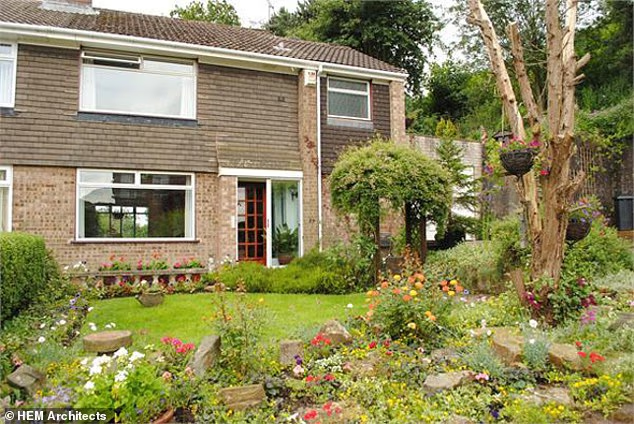
Before: The house in Sheffield before Paul Testa got his hands on it
The 1970s house had clearly been well-loved and looked after, but Paul, an architect, noticed some problems after moving in.
The property was often freezing, making harsh winters unbearable. And a sunroom at the back was either too hot or too cold to use.
‘The house fundamentally didn’t perform’, Paul said.
Paul, who lives with his wife, Kate, 46, their two daughters, Gabriella, 14, and Marilena, 10, and two elderly cats, is not a man to do things by halves.
By 2018, he concluded a cosmetic renovation job would not cut the mustard in his house.
He decided to embark on a major ‘retrofit’ in a bid to boost the property’s green credentials, energy efficiency and make it somewhere he and his family wanted to spend time in.
Paul, a director at HEM Architects, said: ‘Retrofit is about performance. It’s about how the building fabric works: insulation, airtightness, moisture and ventilation. The benefits are felt rather than seen’.
The father-of two ended up shelling out more money on the property’s retrofit than he spent on buying the house.
Paul told the Daily Mail: ‘The biggest problems we faced in the house were poor glazing and air leakage.
‘The windows had very poor 1970s double glazing. In the winter, you’d open the heavy velvet curtains and a wall of cold would hit you. There were also spots where draughts could be felt moving past your body, which was very uncomfortable. And in the summer, overheating was a real problem’.
Before embarking on the major retrofit, the family managed to move into a rental property just up the road from the house.
The 1970s house had already been extended, but ‘badly’, according to Paul, who said the spaces were ‘disconnected and awkward’.
Paul and the trades he appointed demolished the old extension and garage and replaced them with a new two-storey side extension and single storey rear extension.
The timber-frame rear extension has deep studs filled with mineral wool, wrapped externally with wood fibre insulation.
The architect said: ‘The solution wasn’t simply how to make the space bigger. What changed was how the space works’.
Downstairs, the layout was reconfigured into an open-plan kitchen, living and dining area that leads out to the garden. Storage and play spaces were integrated into the design. An extra bedroom was added upstairs and the main bedroom now opens onto a roof terrace.

Before: The kitchen in the Sheffield house before the home underwent a renovation

In the know: Architect Paul Testa will be speaking at next month’s Homebuilding & Renovating Show
How Paul transformed his unassuming semi
Many people would throw in the towel after getting an extension done and reconfiguring the inside of a property. For Paul, this was just the beginning.
The most radical changes were to be hidden in the walls, floors and roof of the previously unassuming semi.
The original suspended timber ground floor was removed and replaced with a heavily insulated concrete raft, which also formed the foundation for one of the extensions.
The existing house was insulated internally, with attention paid to managing moisture and preventing condensation.
Paul, a self-confessed ‘airtightness’ fanatic, was keen to minimise air loss from his house.
He said: ‘Airtightness is about minimising the uncontrolled loss of air from a building. This shouldn’t be confused with ventilation’.

The after shots: Paul Testa’s semi-detached house in Sheffield has been transformed

Streamlined: Paul created a warm and welcoming open-plan kitchen and dining room
Triple-glazed windows were installed throughout and the roof was upgraded with high-quality insulation.
A mechanical ventilation system, which extracts damp air and draws in fresh air from outside, was also fitted, in a move described by Paul as a ‘game-changer’.
Paul sourced the smallest heating system he could, mainly for hot water. The family has a single radiator in the living room and heated towel rails in each of the three bathrooms. The boiler and pressurised hot water tank cost £1,350, excluding installation costs.
A couple of low-wattage portable greenhouse heaters provide ‘occasional’ extra warmth when needed, Paul said.
He added: ‘The better performing home you have, the simpler the heating system and controls can be. In the autumn and winter, we don’t often have the heating on at all. In total, I’d say our energy bills are under £1,000 per year. The solar panels alone help us save £480 a year’.

Easy living: Paul’s new living room is family-friendly and relaxed

Chilling: One of Paul Testa’s daughters enjoying the comfort of life at home

Driven: Paul Testa spent £230,000 excluding VAT undertaking a retrofit on his Sheffield home

Get cosy: Paul Testa’s home is now never too cold in the winter

Thinking differently: Paul Testa thinks too many people view their home as just a financial asset
How much did this all cost?
Paul spent £230,000 excluding VAT on his home’s retrofit, after paying £185,000 for the property in 2013. So, buying and doing up the house cost £415,000.
He told the Daily Mail he now believes the property is worth about £350,000 to £400,000, which is less than the total sum spent on the property to date.
Among other costs, solar panels cost Paul £9,000 and the mechanical ventilation system cost £4,000 to buy and a further £4,000 to install. New windows and doors cost £16,000 to buy and install, timber cladding cost £5,000 to purchase and install and a new kitchen cost £12,000.
Paul said: ‘We worked on a cost-plus contract, where we paid for materials, labour, profits and overheads, rather than a fixed price contract. This enabled us to achieve the best possible outcome without cost constraints.’
He added: ‘The project did put pressure on our family’s finances at the time’.
Is Paul fussed that he has spent more on his home than it is currently worth? Not in the slightest.
He told the Daily Mail: ‘As a nation, I think we’ve got so used to expecting our houses to perform primarily as financial assets rather than as our homes, where we spend a huge proportion of our time.
‘Our homes provide our physical security and how well they function massively affects our health.
‘People are more than happy to see their car depreciating over three years of ownership, but couldn’t conceive a similar “overspend” on their home value over a similar period’.
Paul added: ‘We have an amazing home now. It’s comfortable all year round and the energy bills are low and less exposed to volatility.
‘The air feels fresh, with no condensation or mould risk lurking behind wardrobes. Inside in the summer, it’s never gone beyond 26 degrees celcius, even though it’s 30-plus outside. We’ve changed how it feels to live here. This wasn’t about resale, it was about comfort, health and having control over our bills.
‘It’s an amazingly healthy house to live in and to bring our daughters up in. This last point alone is almost priceless’.
What’s next on Paul’s agenda? A heat pump
Paul believes a heat pump in his house could shave a further 17 per cent off his annual energy bills.
He said: ‘If I did our retrofit today, I’d definitely install a heat pump.
‘I do really support Ed Miliband’s drive to get more heat pumps in people’s homes.
‘Heat pumps are the fastest way to decarbonise our homes, and if energy costs weren’t an issue, would be a great solution for 90 per cent of our housing stock.
‘However, in energy cost terms, they’re unlikely to save homeowners much money unless they’re really efficient, or if they’re combined with building fabric measures at the same time.
‘It’s when they are combined with solar and batteries that the running costs, to my mind, can start to make sense’.