
Nissan has warned ministers that it could be forced to shutter the largest car factory in Britain if the EU fails to include the UK in its ‘Made in Europe’ rules being ironed out in Brussels, according to reports.
The Financial Times sources ‘three people with knowledge of discussions’ between Nissan executives and the UK Government, in which the car maker is said to have expressed its concerns about UK manufacturers being penalised in the plans, suggesting it could close the Sunderland plant in the North East as a result.
The Made in Europe rules would effectively require at least 70 per cent of new electric vehicle components to have been produced in EU countries to qualify for various incentives.
Manufacturers would need to meet this threshold for electric, hybrid and hydrogen fuel cell cars to be eligible for public subsidies, public procurement, and leasing schemes in an effort stem the tide of cheaper vehicles arriving from China and taking market share away from European legacy brands.
But while the UK and Japan have been included in the main element of the rules to qualify for incentives, it is at risk of being omitted from some key markets, including lucrative corporate fleets.
Nissan GB told us that the rules risk ‘creating confusion and adding unnecessary complexity for the industry’.
Nissan, the UK’s biggest car maker, has warned it could its Sunderland plant if the EU excludes it from its ‘Made in Europe’ rules being ironed out in Brussels, according to reports
The measures proposed by the EC are designed to save Europe’s struggling €2trillion industrial base from growing competition, specifically from China.
However, the UK motor industry’s gripe with the rules is around stricter requirements for corporate fleets and small electric vehicles.
Corporate fleets make up a sizable share of car sales across Europe – around six in 10 models sold. For some car makers, the segment accounts for as much as half of their annual sales.
But under the European Commission’s recommendations presented on Wednesday, only vehicles for these markets assembled within the bloc would be eligible for the Made in Europe benefits.
This would put the likes of Nissan, Jaguar Land Rover and Toyota – all of which make vehicles in the UK for the European markets – at a significant competitive disadvantage to those making cars on the continent.
This could trigger executives to reconsider their production bases in Britain, as well as those producing car parts here.

The Made in Europe rules would effectively require at least 70% of new electric vehicle components to have been produced in EU countries

While the UK has been included in the broader Made in Europe rules, it has been omitted for cars delivered for corporate fleets, which make up around 60% of car sales on the continent
The FT reports that the UK has been intensively lobbying for the UK to be granted full access to the scheme, with business secretary Peter Kyle said to be taking the potential threat to Britain’s car makers ‘really seriously’ and is prepared to step up efforts to ensure their inclusion to protect the sector.
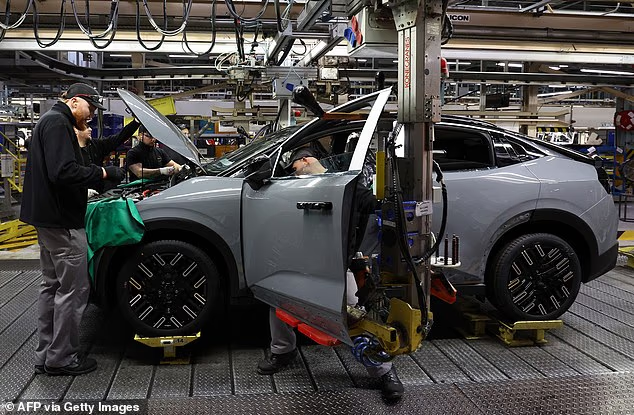
While acknowledging the impact of the rules, sources at Nissan GB have told Daily Mail and This is Money that it has not threatened to close the Sunderland factory, which employs around 6,000 people and produces a new car every two minutes.
In an official statement issued to Daily Mail and This is Money on Thursday, a Nissan GB spokesman told us: ‘We’re pleased the Commission has addressed industry concerns and recognised how important partners are to the EU supply chain, by allowing ‘content equivalent to Union origin’ to count under the Act.
‘This change should let vehicles built in these locations – which often include a lot of EU made parts – qualify for government purchasing and national EV incentives.
‘However, using a different definition for corporate fleets and the small car super credit creates confusion and adds unnecessary complexity for the industry.
‘A simple solution would be to apply the ‘equivalent to Union origin’ rules across all types of EV support, which would be in line with the EU’s goal of making regulations easier to understand and apply.’

The Sunderland factory is the biggest car plant in Britain, employing around 6,000 people and producing a new vehicle every two minutes
Mike Hawes, chief executive at the Society of Motor Manufacturers and Traders, Britain’s automotive industry’s trade body, said he is ‘gravely concerned’ by the UK’s potential partial omission from the Made in Europe rules, saying it would put UK manufacturers at a ‘systemic competitive disadvantage’.
He also suggested the rules could be in breach of the EU-UK Trade Cooperation Agreement negotiated as part of the Brexit deal.
‘As drafted, it would discriminate against UK-made vehicles and components, damaging a trading relationship worth almost £70billion annually.
‘It is a position that the UK industry and government sought to avoid, given we are both each other’s largest customers and suppliers.’
Hawes added: ‘The UK government and European counterparts must work together urgently to resolve the situation, extending full, trusted partner status to the UK automotive sector.
‘This is not just to ensure choice for British and European consumers – especially in zero emission vehicles – but to deliver the economic growth and security everyone craves.’
Figures published by the SMMT last month revealed that UK vehicle production in 2025 had crashed to a 73-year low in what it described as the ‘toughest year in a generation’.
Just 764,715 vehicles – 717,371 cars (down 8 per cent) and 47,344 vans (down 62 per cent) – rolled off assembly lines in 2025.
This is the lowest manufacturing volume since post-war 1952 – excluding the Covid-19 lockdown years – and is down 52 per cent on 2015 outputs when some 1.6 million motors were being made in Britain.
The slump was triggered by significant declines posted by two of the nation’s biggest car makers.
Jaguar Land Rover saw outputs fall by almost 22 per cent as a result of Jaguar pausing production for a year as part of plans to reboot as an electric-only luxury brand in 2026.
JLR outputs were also hammered in the months of September and October after it fell victim to a cyber attack that forced it to temporarily close its cars plants in Britain – and across the world – for more than five weeks.
Another notable production crash was recorded by Vauxhall’s parent firm Stellantis, with vehicle outputs down a monumental 71 per cent in the wake of the closure of the 120-year-old Luton van factory last March.
The SMMT’s data shows that Europe is by far the UK’s largest vehicle export market, with 56 per cent of motors shipped to the continent last year.
This is followed by the US (15 per cent), and China (6.3 per cent).
Nissan was the UK’s biggest car producer last year.
Its factory in Sunderland 273,322 cars in 2025, which was a decline of 3.1 per cent on 2024 outputs.
However, the North East site has seen a significant shift in the last 12 months as it began production of the all-new electric Leaf – which went on sale only a matter of months ago – and has already started to prepare its assembly lines for a new electrified Juke coming this year.
The Qashqai – which was Britain’s third most popular new car by sales – was also named the most exported UK-made vehicle of 2025.