
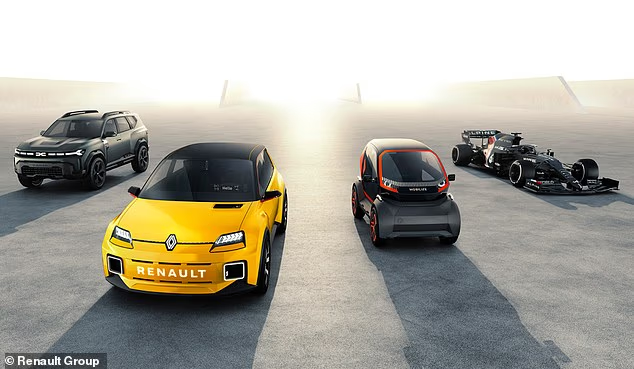
The Renault Group has set out ambitious new plans to become ‘the benchmark European car maker’ – and it won’t scale back its electric vehicle ambitions.
The French motor giant – which owns Renault, Alpine and Dacia – has committed to launching 36 new models between now and 2030, ‘accelerating electrification and also its international range’, it said in an official presentation on Tuesday.
The group, which saw sales of 2.3 billion vehicles and revenue reach €57.9billion in 2025, welcomed new CEO Francois Provost in July. Provost took over from Luca de Meo, who left Renault for luxury fashion group Kerring.
Provost says the new strategy will ‘set the Group on a path to robust and sustainable performance, whatever the challenges ahead.’
Despite implementing this plan ‘collectively’, each manufacturer under the Renault banner has individual strategies, though electrification is a major pillar among its intentions to deliver new model generations and increased sales targets.
This is despite many manufacturers scaling back their electric plans, with Lamborghini the latest to axe its first EV on the back of limited customer demand.
Here’s what you need to know about Renault Group’s new strategy and the cars it will deliver in the next four years.
French car giant, the Renault Group, has announced its ambitious 2030 ‘futuREady’ strategy. Here’s what you need to know and what Renault, Dacia and Alpine are doing
‘futuREady’ – what is it and what are the pillars?
Renault has unveiled what it has dubbed its ‘futuREady’ strategy.
This ‘revolves around the product and the customer experience, technological innovation and operational excellence’.
The plan is to maintain dynamic growth long term and generate consistently robust and resilient financial results in the medium term.
Specifically, the Group is aiming for an operating margin of between five and seven per cent revenue and an average free cash flow for Automotive of at least €1.5billion a year.
It builds on Renault Group’s ‘Renaulution’ strategic plan of 2021, which involved ‘clear complementary brand positioning and ‘value-orientated product renewal’.
Provost sets out the four strategy pillars as: growth ready, tech ready, excellence ready and trust ready.
While maintaining the Group’s strong base in Europe is forefront, with ‘products even more closely aligned with customer expectations’, the Group is also ‘stepping up the pace’ in its ‘growth hubs’ including India, South America, and South Korea.

Renault Group CEO Francois Provost delivered the new strategic plan in a presentation at the firm’s Technocentre in Guyancourt, near Paris, on Tuesday morning

Renault is aiming for 2million vehicles sold every year outside of Europe by 2030 and 100% electrified sales in Europe
Renault
– By 2030, the brand is aiming for: Over 2million vehicles sold every year, half outside Europe
– 100% electrified sales in Europe and 50% outside Europe
Renault will be strengthening brand positions in Europe, deploying electrification across the range and stepping up the brand offensive on international markets.
The brand strengthening will see Renault launch 12 new products by 2030.
In terms of electrification, Renault will expand its full hybrid E-Tech offering beyond 2030 in Europe and internationally and will bring out a new generation of EVs based on its new RGEV medium 2.0 platform – designed for European markets.
These new EVs will be ‘built for range, efficiency and fast-charging’ thanks to the new platform.
Renault’s small EV offerings already include the new Clio, 4 and 5 E-tech and Twingo E-tech.
The electrification of commercial vehicles will also be stepped up with the new Trafic van E-Tech electric.
The in-car experience will be reinvented with the spirit of ‘voitures à vivre’ and designed with bright, modular cabins designed for living. Renault will also continue to reinterpret the cockpit with a ‘human-centric’ approach that sees infotainment tech able to be controlled as naturally as if it were a smartphone.
Concept model:
Renault Bridger Concept is a sub-4-metre SUV that ‘expresses Renault’s ongoing international offensive’.
The B segment car will be made for urban driving and while it will look small on the outside, Renault promises it will set standard in its class for space and roominess. The boot will fit 400 litres worth of stuff.
Renault says the model will start production in India, and the production model is expected before the end of 2027.
It will be available in combustion, hybrid and electric versions depending on the market.
Dacia
– Deploy the most competitive offering based on price, cost and value for customers
– Accelerate electrification to reach two-thirds of sales in 2030
Dacia is the inexpensive Romanian brand that’s sold more than 10 million cars worldwide between the launch of the Logan in 2004 and the end of 2025.
Now it’s embarking on a 2030 roadmap that includes the launch of four electric vehicles – EVs that will continue the brand’s ‘benchmark for affordable, essential and robust mobility’.
Dacia’s strategy is distinctive due to its positioning as the best-value-for-money brand.
It’s due to its disciplined and highly efficient design-to-cost philosophy that Dacia can deliver a structural cost advantage of 15 per cent compared to the market.
The lean distribution model operates at less than half the average cost of Western European competitors – making Dacia highly competitive.
This foundation will be reinforced through five pillars: a move to electric mobility, accelerating electrification, a strong family car offensive and a new-generation Sandero – the cheapest petrol model sold in the UK.
The move to electric mobility will see four fully electric models launch by 2030. The move will begin this year with the launch of a new A segment EV using Renault’s AmpR Small platform.
Manufactured in Europe, the city EV will be developed in less than 16 months and will cost less than £15,575 (€18,000).
From then on, electrification will rapidly expand until Dacia sees two-thirds of its sales electrified.
This includes a new family-size SUV (which we will come to later).
The Sandero, which has been a success for over 20 years, will soon be available with a fully multi-energy powertrain range in its next generation.
Though Renault Group promises it will remain the segment’s value-for-money benchmark.

Dacia’s new C segment Striker SUV will combine ‘the dynamism of a station wagon, the practicality of a spacious hatchback and the ground clearance of an SUV’

Prices for the Striker are expected to start from around £22,000 – based on the €25k figure. This would see it become the most inexpensive large SUV on the market by some magin
The Striker – Dacia’s new model:
The C segment SUV will combine ‘the dynamism of a station wagon, the practicality of a spacious hatchback and the ground clearance of an SUV’.
With typical Dacia visuals – like the brand’s new, modern daytime running light signature – the Striker will also deliver strong aerodynamics and everyday usability.
It will be fully revealed in June and will sit alongside the Bigster in the C segment, measuring 4.62m in length.
Buyers will be able to choose from a hybrid, hybrid 4×4 and an LPG variant.
Prices will start below the £21,600-ish mark (€25,000).

Alpine will focus on growth goals of existing models and development of its new Alpine Performance Platform
Alpine
– Focus on growth goals with Alpine A290 and Alpine A390
– Offer first ‘true’ EV sportscar
The premium sports car brand is part of the Renault Group’s mid-term growth plan as it has been growing significantly since 2018 – the launch of the A110 model.
Alpine will be focusing on the development of its Alpine Performance Platform – APP. This will underpin different body styles that will launch in the coming years; coupe, spider and 2+2.
The future generation of the Alpine A110 will use this platform – a platform that aims to address ‘all the technical challenges around weight, design and electrification’.
Alpine is also developing a ‘high-tech brain’ for the platform called the Alpine Dynamic Model. It will integrate seamlessly into everything from; battery management to the e-motors, brake management, steering and active aerodynamics.
Alpine will also introduce torque vectoring to its next generation of EVs, called Alpine Active Torque Vectoring, to ensure a true lightweight feel.