
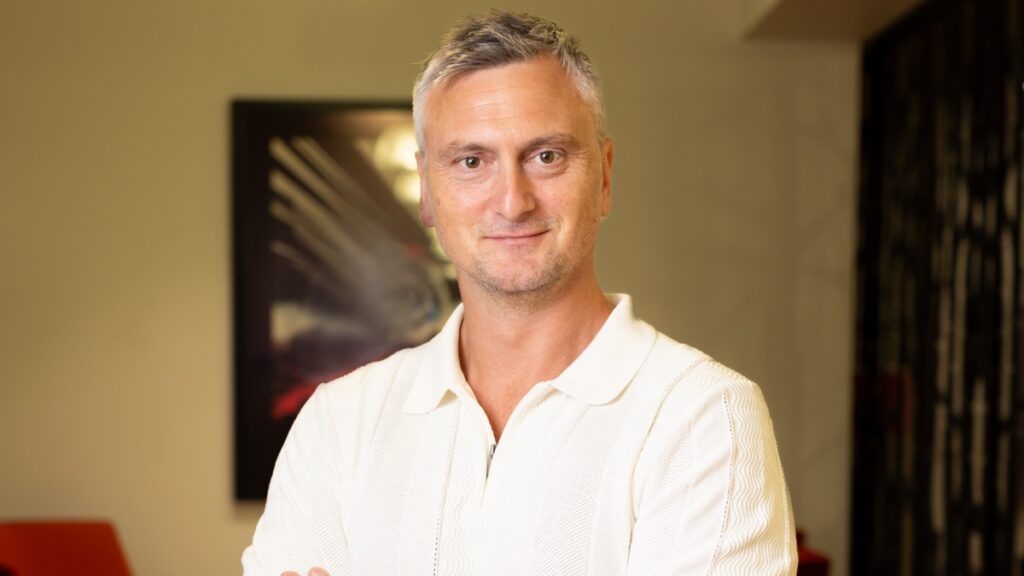
US software stocks are sliding and the term ‘SaaS-pocalypse’ is trending. Blackpearl CEO Nick Lissette tells why the real threat is losing sight of your fundamentals.
What’s happening: Blackpearl Group Founder and CEO Nick Lissette is pushing back on panic in the tech sector following a slide in US software stocks tied to rapid AI agent adoption.
Why this matters: For Australian and New Zealand tech businesses, from startups to established SaaS providers, the question of how AI agents reshape competitive markets is no longer theoretical.
The term “SaaS-pocalypse” has been circulating in tech circles since recent advances in AI agents sent US software stocks into a slide. Nick Lissette, Founder and CEO of New Zealand-listed Blackpearl Group, has a more measured read on what is actually happening.
“We are now living in an age of great uncertainty,” he says. “There will be something new emerging every day. That volatility isn’t going away. It’s the new normal.” But Lissette is not here to catastrophise. He is here to reframe.
Not a shark, piranhas
The immediate trigger for market jitters has been the rapid proliferation of AI agents. OpenClaw, one platform tracking this shift, has reportedly generated 1.5 million AI agents in just over three months. For SaaS businesses built on feature-based models, the implication is uncomfortable.
“You no longer compete with one or two scaled rivals,” Lissette says. “You compete with thousands of micro-competitors. It’s not a single shark, it’s piranhas. Each agent can automate a narrow slice of functionality that customers previously paid SaaS providers for. One slice doesn’t matter. But enough slices over time can hollow out a product. That’s a real dynamic, and the market is responding to it.”
The concern for established software businesses is margin pressure, as individual agents begin automating tasks that once justified subscription fees. Lissette does not dismiss this. But he draws a clear line between acknowledging the pressure and losing perspective.
“What concerns me more is that in all the noise, companies can lose sight of the fundamentals,” he says. “Technology doesn’t win on its own. Delivering genuine customer outcomes is the true north. It has to start and finish there.”
The fuel providers win
Lissette’s core argument is about what sits underneath AI agents, and what makes them actually useful.
“An agent is only as powerful as the information it runs on,” he says. “Intelligence without knowledge is noise. If it runs on deep, structured, proprietary knowledge, it becomes exponentially more valuable. That’s where the leverage shifts and the fuel providers are set to win.”
For Blackpearl Group, which operates in the data and intelligence space, the proliferation of agents looks less like a threat and more like a demand signal.
“OpenClaw hasn’t just created 1.5 million agents,” Lissette says. “It may have created 1.5 million new consumers of high quality data and buying signals almost overnight.”
He describes the current repricing in global software markets not as a collapse but as a reassessment of where value actually sits. Companies with strong, structured, proprietary data foundations, he argues, could find themselves in a stronger position than before.
Evolution, not extinction
For businesses trying to make sense of the moment, Lissette offers a practical filter.
“Once you are clear on the outcome you deliver for customers, you then select the tools and data required to achieve that,” he says. “AI is one of those tools, powerful, yes, but still a tool. This is less about extinction and more about evolution.”
The question he wants technology businesses to sit with is a direct one. “Companies need to ask: is our value in features that can be automated, or in data and insights that can’t easily be replicated?”
The harder challenge, Lissette acknowledges, is that the pace of change makes traditional strategy cycles obsolete.
“The challenge is that everything now moves at extraordinary speed,” he says. “You can’t set strategy annually and hope it holds. You have to evolve in real time.”
His closing message for the sector is deliberately split. “Brands should be reevaluating where their real defensibility sits. If your edge is workflow alone, you need to move fast and to do so now. If your edge is structured data and proprietary knowledge, this shift could help accelerate your advantage.”
For tech businesses watching US markets and wondering what to do next, Lissette’s position is clear. The SaaS-pocalypse is not the end of the story. It is, for those paying attention, closer to the beginning of a more interesting one.