
Global markets are bracing for another torrid week as the Middle East conflict showed no signs of slowing over the weekend.
Oil prices surged above $100 a barrel in the early hours as investors priced in further disruption with the Strait of Hormuz effectively shut, and key suppliers signalling cuts to production over the weekend.
Brent crude rocketed to nearly $120 a barrel overnight before settling at around $107 on reports that G7 ministers will discuss a joint release of petroleum from reserves.
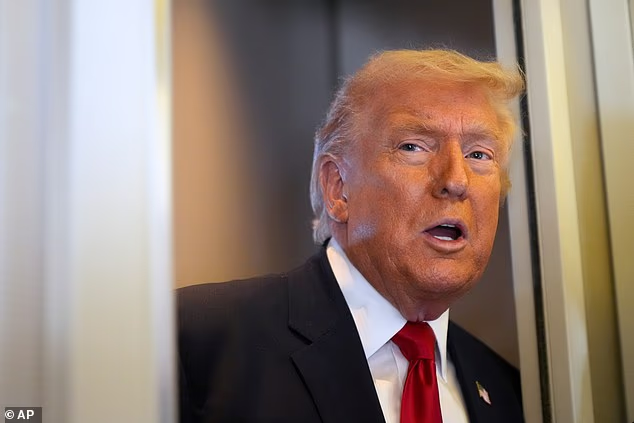
Oil prices are now around 60 per cent higher than they were before the war started, but Donald Trump has said the spike in prices is ‘a small price to pay’.
In a social media post, he said: ‘Short-term oil prices, which will drop rapidly when the destruction of the Iran nuclear threat is over, is a very small price to pay for U.S.A., and World, Safety and Peace’.
Donald Trump says the spike in oil prices is a ‘small price to pay’
Analysts expect oil prices to rise further if disruption continues, with Goldman Sachs expecting prices ‘to exceed 2008 and 2022 peaks’ and head above $150 by the end of the month if the Strait of Hormuz remains shut.
Chris Beauchamp, chief market analyst at IG said: ‘Investors have woken up to an oil crisis. It may have taken a week, but oil prices have finally crossed the $100 mark that everyone expected would happen if Hormuz was closed. The market is now facing its biggest crisis since Liberation Day, and arguably since Covid.’
Asian markets suffered sharp falls overnight, with Japan’s Nikkei 225 down 5 per cent while South Korea’s Kospi plunged as much as 9 per cent.
The FTSE 100 has been swept up in the selloff this morning, opening down 1.73 per cent, or 180 points, to 10,103, having shed over 600 points last week.
The Stoxx Europe 600 index plunged 2 per cent, while Germany’s Dax is down 2.4 per cent. US futures are pointing to losses of around 1.5 per cent, extending last week’s rout.
There is mounting concern among investors that a prolonged conflict could lead to stagflation – slowing growth paired with rising inflation – or even recession, as rocketing prices push central banks to tighten policy.
Susannah Streeter, chief investment strategist at Wealth Club said: ‘Higher energy prices and borrowing costs will be a drag on growth, and the concern is that governments lack the financial firepower, given high debt levels, to deliver meaningful support to companies and consumers.
‘The spectre of stagflation is hovering, with high inflation and stagnant growth looking increasingly likely unless there’s a rapid de-escalation in the Middle East.’
Money markets have already effectively ruled out the Bank of England cutting rates in this month’s meeting, with an increasing chance of a rate hike later this year.
Government bonds are also under pressure, extending their losses from last week. The 10-year gilt yield rose 0.13 percentage points to 4.76 per cent, while the two-year gilt yield rose 0.19 percentage points to 4.06 per cent.
This will pile pressure on Rachel Reeves, who may also be pushed to consider an energy bailout as gas prices skyrocket to near 2022 levels.
Already, energy firms have pulled many fixed tariffs for households – with warnings that Ofgem’s price cap will rise sharply in July, if the conflict continues.
This morning, UK gas futures surged over 20 per cent to 155.8p per therm, nearly double the level seen before the conflict started. Similarly, European gas prices are up around 20 per cent to €64/MWh, the highest level in three years.
DIY INVESTING PLATFORMS
AJ Bell
AJ Bell
Easy investing and ready-made portfolios
Hargreaves Lansdown
Hargreaves Lansdown
Free fund dealing and investment ideas

interactive investor
interactive investor
Flat-fee investing from £4.99 per month

Freetrade
Freetrade
Investing Isa now free on basic plan

Trading 212
Trading 212
Free share dealing and no account fee
Affiliate links: If you take out a product This is Money may earn a commission. These deals are chosen by our editorial team, as we think they are worth highlighting. This does not affect our editorial independence.
Compare the best investing account for you