
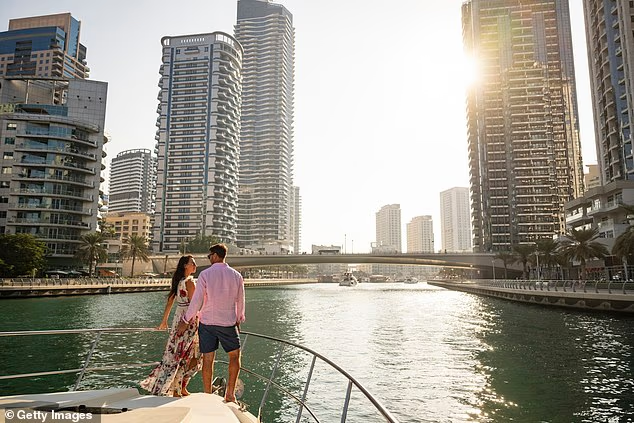
Dubai has thrived on a glamorous and glitzy image, attracting hundreds of thousands of Britons seeking a sun-soaked, tax-free lifestyle.
But the city’s prized status as a safe oasis has been shattered by the hundreds of missiles and suicide drones directed at its landmark hotels and residential areas in recent days.
Expats living in Dubai have been shaken by ‘scary’ loud bangs overhead and vibrations underfoot as Iran’s strikes rage on.
While many say they feel safe sheltering in their homes and the United Arab Emirates’ air defences successfully intercepts the vast majority of attacks, it’s hard to believe the shock won’t have long-lasting consequences for jobs, house prices and finances of those living there.
British expats who have built their lives and started businesses in Dubai tells us they hope the conflict will pass in the next few weeks and life will resume as normal. They will only have to consider uprooting if the conflict is sustained. Few are able to talk openly, as the UAE authorities have warned that reposting rumours online can lead to prosecution.
One British man, who has lived in Dubai for three years and didn’t want to be named, said it was far too soon to talk about moving away and that he felt safe despite the ongoing noise from intercepted missiles.
He said: ‘I can hear the cracks all the time but it will all pass quite quickly I think and there’s definitely not a feeling of “We need to leave now”. No one is going to have a knee-jerk reaction.’
Dubai has thrived on a glamorous and glitzy image, attracting hundreds of thousands of Brits seeking a sun-soaked, tax-free lifestyle

While many British expats in Dubai expressed confidence in how the situation was being handled, some experts have said the conflict could have disastrous consequences for the property market if the disruptions go on for much longer.
Another expat said that he thought the situation had been handled brilliantly by the UAE authorities. Although he can hear the sounds of attacks from his home, he still feels safer than when he used to live in the UK. ‘There are some loud noises but you don’t feel like you’re in a war zone. London still seems more dangerous to me. We are here for the long run.’
However, some have said the conflict could have disastrous consequences for the property market if the disruptions go on for much longer.
Dubai’s property market has become one of the most compelling investment stories in the world in recent years, according to real estate giant JLL. The desert metropolis has delivered exceptional returns for investors or those who have bought homes in the region thanks to growing numbers moving there and driving up demand.
But there are fears that many aspiring expats could think twice before relocating to Dubai and those who are there may consider leaving.
Few parents will be comfortable with the idea of missiles flying overhead while their children sleep at night – particularly those who moved to Dubai in search of a life of luxury.
Armand Arton, chief executive of financial adviser Arton Capital, says families with young children could be among the first to consider a move out of the country. He says: ‘The ongoing geopolitical situation has unsettled many internationally mobile families and expats living in the UAE.
‘The Emirates has long been considered as one of the most stable regional hubs, so any direct security incident inevitably prompts globally minded entrepreneurs and families – particularly those with young children – to reassess their risk exposure and contingency planning.’
Nine in ten of the 3.4million people living in Dubai are foreign nationals, which means many do not have the deep ties to keep them in the country should their safety be at risk. If even a small proportion chose to leave, the property market would take a hit.

Anyone thinking of moving out of Dubai due to the recent conflict is advised to fully assess the implications before making any quick decisions
As Ruth Sunderland reported, it has already become much shakier in the past 48 hours, which is worrying for Britons who, according to Sotheby’s, are the second largest group of buyers in Dubai after Indian purchasers.
House prices have soared in Dubai as the property market has turned red hot in recent years. Real estate prices rose 60 per cent between 2022 and the start of 2025, according to ratings agency Fitch.
But the current crisis could derail this growth if buyers press pause on decisions to buy a home in the glamorous city, until a clearer picture emerges.
Dubai is known for having a highly speculative market, as many new luxury developments sell out before construction even starts.
Some analysts already warned last year that prices were due a fall. In May last year, ratings agency Fitch warned Dubai faced a double-digit property price correction between the second half of 2025 and 2026. The trusted US agency said that prices could fall by up to 15 per cent due to a surge in new deliveries of housing in the city, which could lead to oversupply in the market.
Recent developments could speed up any market downturn. Many who work in real estate and live in Dubai have taken to social media to broadcast their fears over a crash.
One wrote: ‘I work in Dubai Real Estate. House prices will take such an extraordinary drop, that it would be fantastic for buyers/investors, but horrendous for sellers. The war won’t last for ever, therefore when it ends, property prices will rise and everyone that purchased will likely more than double their money.’
Andrew Cummings, head of residential property in the Middle East for estate agents Savills, says that it is too early to say what the broader impact of the conflict may be, although historically Dubai has a strong track record of overcoming challenges. ‘Fundamentally Dubai’s market has matured considerably in recent years,’ he says. ‘It is built on strong fundamentals, a growing economy, billions of dollars of infrastructure investment and an attractive business regime.
‘Government’s response to this crisis has been exemplary.’
Expats who are considering a return to the UK should try to plan their move well ahead of time to make sure they don’t fall foul of any tax rules. Leaving quickly could prove difficult for some.
Anyone who has been away for more than a full tax year and less than five years will be considered a temporary non-UK resident. This means if you decide to return to the UK, your resident status will be reinstated, according to digital tax platform Taxfix.
However, you may be hit with a surprise tax bill by HM Revenue & Customs. This is because you have to pay tax on certain income or gains made while you were non-resident, for example on capital gains or certain pension payments. This doesn’t include wages or other employment income.
If you have been away for more than five years you will usually be classed as a UK resident again. This means you pay UK tax on your UK income.
Before returning to the UK, the UAE requires you to cancel your residency status, cancel your work visa, close all bank accounts and pay any outstanding fines or debts.
In Dubai, a residential property is typically sold within 40 to 60 days, and in some cases, it can take two to three months if the buyer wants to perform multiple checks, according to local real estate firm Lex Estates.
However, the property sale process slows down during Ramadan (February 17 – March 18 this year) and the hot summer months, when many buyers travel or wait.
Anyone who is thinking of moving out of Dubai due to the recent conflict must make sure to fully assess the situation before making a knee-jerk decision.
Peter Clark, chief executive of global wealth management firm Bentley Reid, who is based in Dubai, said: ‘We have spoken to multiple clients and industry contacts since the conflict began. Overall, there is a collective sense of calm and reassurance that the UAE authorities are handling the situation effectively.
‘The discussions are focused on the general uncertainty, their personal/family circumstances and how/when the conflict may end.’