
Britain is facing another energy price shock just four years after the country was plunged into a cost-of-living crisis, in part prompted by rising bills after the Russian invasion of Ukraine.
Natural gas prices in Europe and the UK have soared again this week as the Middle East conflict disrupts supplies.
While gas prices haven’t yet reached their 2022 peak, which saw energy bills rise to unmanageable levels for many, experts warn that a prolonged conflict could push the Ofgem price cap to as high as £2,500. It is currently £1,758.
With energy suppliers already pulling some fixed tariffs and forecasting a potential rise in the price cap, Britain could face another energy crisis.
So, why is Britain so vulnerable to these price shocks and what will it mean for energy bills?
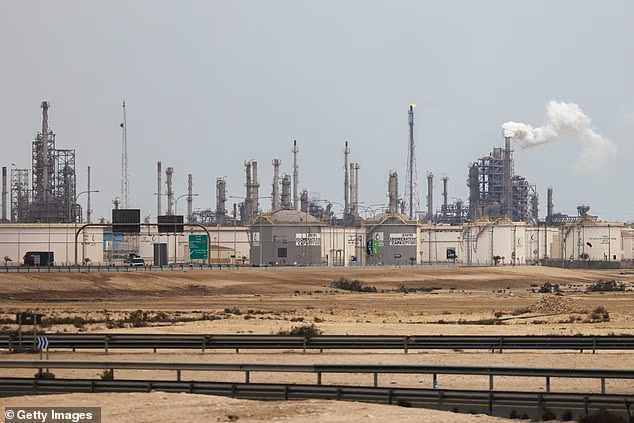
Gas price shock: Qatar announced the shutdown of its gas production this week
Why is the UK so exposed to gas market shocks?
The Ukraine crisis exposed the UK’s vulnerability to gas market shocks, with the government forced to intervene with the Energy Price Guarantee in 2022.
It effectively subsidised household energy bills to bring them down to £2,500 per year for the average customer.
This week shows that those weaknesses remain.
Britain still uses a lot of gas, and around 85 per cent of households still rely on gas for heating, according to a report by the Onward think tank.
There has been a failure to produce enough gas domestically – which has happened over decades – and the UK will not be able to meet heating demand by next year, according to analysis by campaign group End Fuel Poverty.
While successive governments have piled money into renewable alternatives, offshore wind farms take time to build, leaving Britain reliant on gas imports.
While the vast majority of gas imports are sent from Norway, the UK also relies on Qatar, which this week halted production of liquefied natural gas (LNG).
Crucially, Britain has less gas storage than Europe – at the end of February, domestic storage was less than 30 per cent full.
This adds volatility to prices because of concerns over the security of supply. While gas prices largely move in parallel, European natural gas prices have jumped 70 per cent, while UK prices are slightly ahead with a 75 per cent increase this week.
The solution is not straightforward. Britain’s energy auction system means that the most expensive energy source on a unit basis, usually gas, sets the marginal price of electricity. So even as more households move away from gas, they remain exposed to supply disruptions.
‘Due to the lack of sufficient nuclear, wind and solar power to meet demand, gas is still needed and sets the marginal wholesale price 97 per cent of the time,’ says Onward.
‘Britain is therefore more beholden to gas prices than France, where nuclear generation sets relatively stable prices, or Germany, which historically has a mix of goal, gas, and hydro setting prices.’
Dwindling domestic gas production and disrupted imports leave Britain in a difficult position, with no immediate solution.
Energy Secretary Ed Miliband told MPs this week that ‘as when Russia invaded Ukraine, we will be exposed to price competition’.
Greg Jackson, founder of energy supplier Octopus, this week urged the government to ‘use what’s available’ in the North Sea.
However, Miliband has maintained that no new oil and gas licences should be issued in the North Sea, and that net zero is the best approach to improve energy security.
What does it mean for our energy bills?
In the immediate term, households are protected from rising wholesale prices whether they’re signed up to a fixed or variable deal.
Households on a fixed deal will continue to pay their current unit rate until their deal ends, while those on a standard variable tariff are protected by the Ofgem set energy price cap, which will fall by over £100 from April.
From next month, the typical dual fuel household will pay £1,641 for their energy and will be protected until July, when the price cap changes again.
If the Middle East conflict resolves relatively quickly, the impact on households should be minimal, but if gas prices continue to rise, then it could flow through to the price cap by the summer.
That’s because Ofgem uses the average prices during the three-month observation window and other related costs.
However, we’re already starting to see ructions in the energy market as suppliers start to pull fixed deals. Last Saturday, there were 38 tariffs on the market. However, by Thursday there were only 17 available.
It’s also becoming more expensive to fix your energy bill. The cheapest tariff for an average household was £1,509 last week, which increased by £131 to £1,640as of Wednesday.
It came after expert forecaster Cornwall Insight said it expects the price cap to rise by more than £150 from July if gas prices stay high.
> Is it a good idea to fix your energy deal now? Read our guide
SAVE MONEY, MAKE MONEY

4.54% cash Isa
4.54% cash Isa
Trading 212: 0.94% fixed 12-month bonus

£100 cashback
£100 cashback
Transfer or fund at least £10,000 with Prosper
.jpg)
4.61% cash Isa
4.61% cash Isa
Includes 12-month boost for new customers

£3,000 cashback
£3,000 cashback
1% cashback up to £3,000 when transferring

Earn up to £3,000
Earn up to £3,000
£100-£3,000 cashback for joining
Affiliate links: If you take out a product This is Money may earn a commission. These deals are chosen by our editorial team, as we think they are worth highlighting. This does not affect our editorial independence. Terms and conditions apply on all offers.